BOUND Book Arts Fair, Sunday December 11th, in Toronto

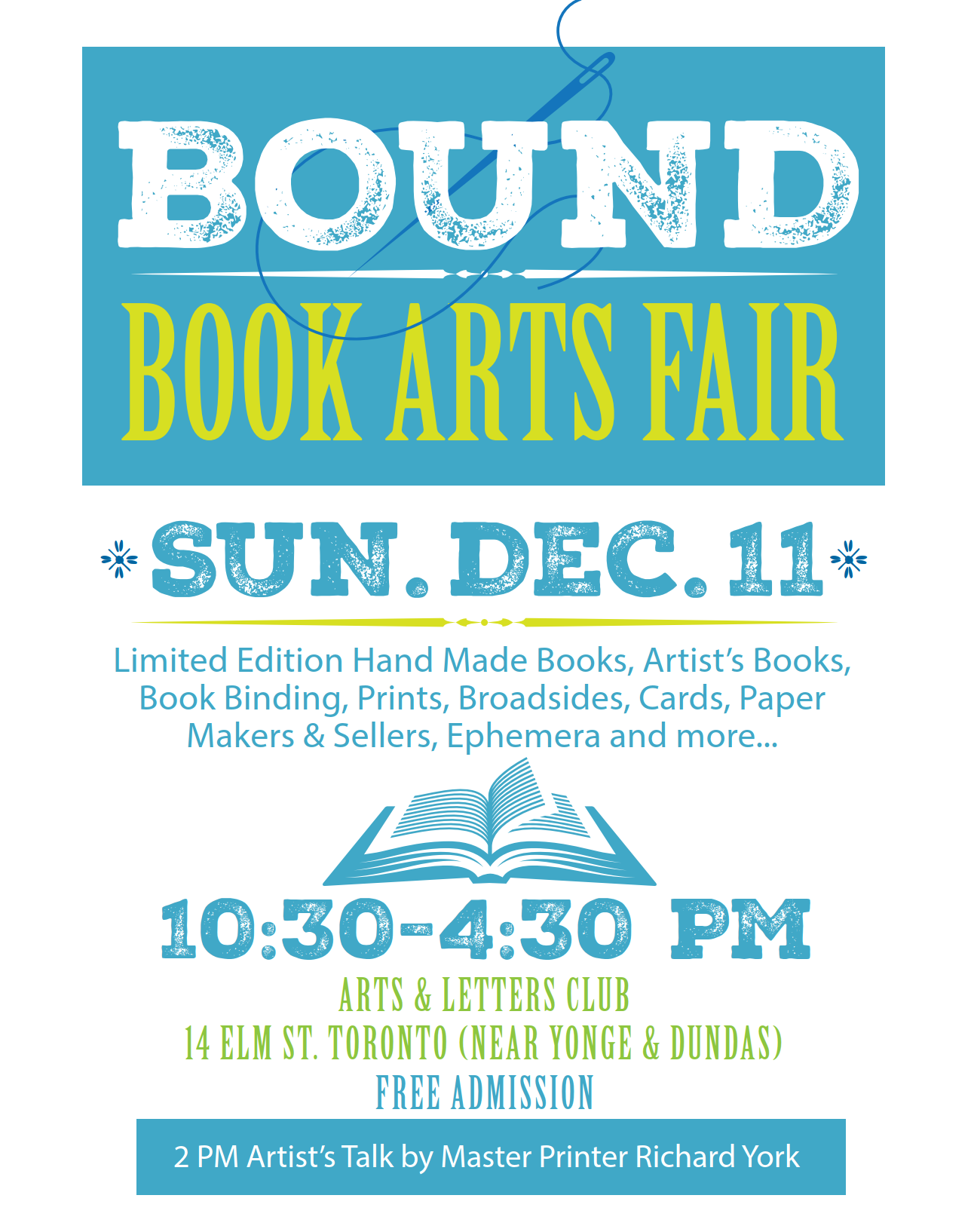
After a couple years of COVID hiatus, the BOUND Book Arts Fair is back!

This year’s Fair will be held from 10:30am to 4:30pm at the Arts & Letters Club located at 14 Elm Street, near Yonge & Dundas in downtown Toronto.

We are lucky enough to have a table at this fair, this time upstairs in the Studio, where we will be selling some of our paper, marbling, bookbinding supplies, and assorted books related to the book arts. The Studio is on the third floor, but has lots of windows for plenty of natural light, and there is an elevator available if you can’t handle the stairs.

In addition to all the vendors there, this year will feature an Artist’s Talk by master printer Richard York at 2pm. Richard comes to us all the way from Salt Spring Island, BC.

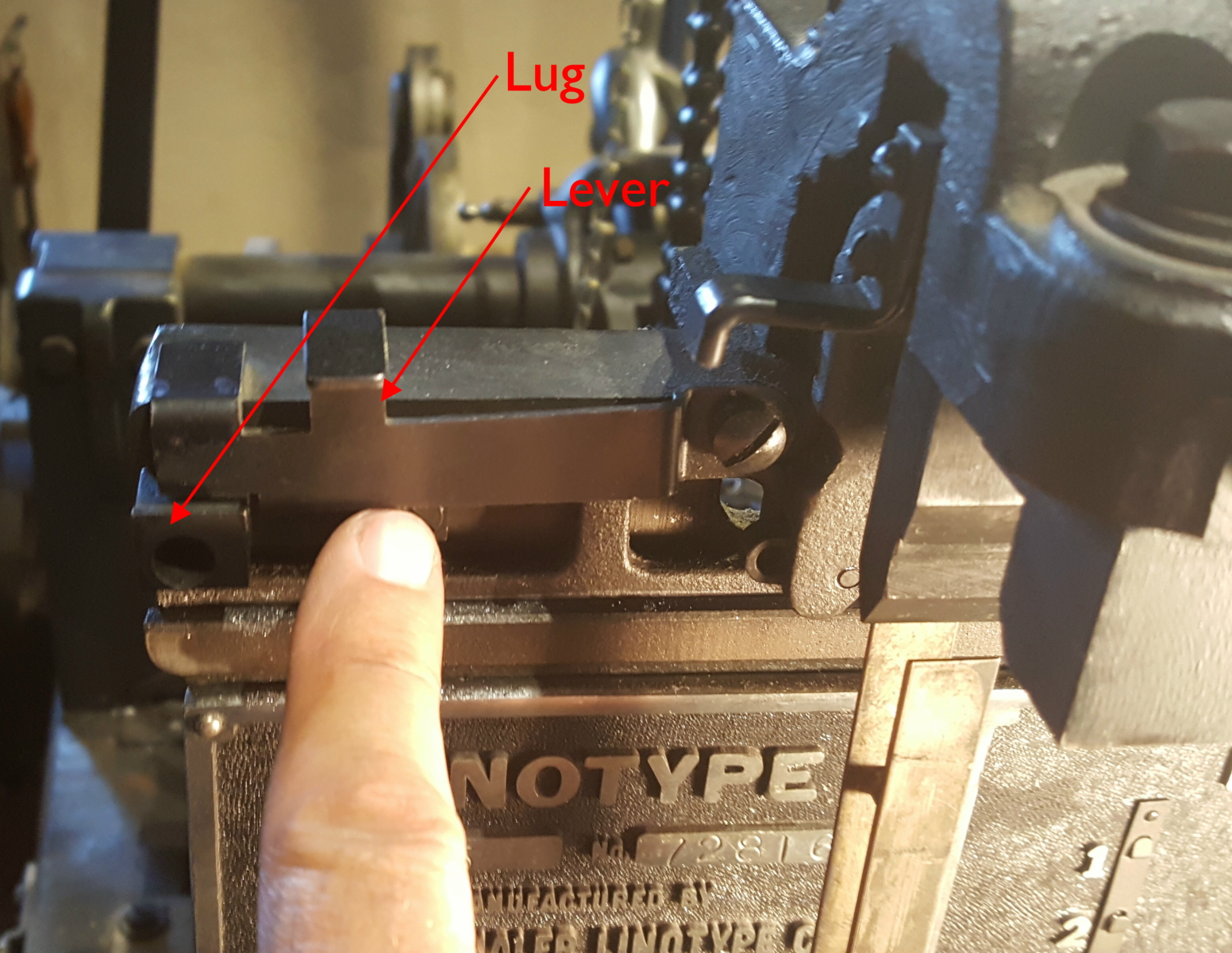
Progress on the Mackenzie Printery’s Linotype (Second Elevator Transfer, part 3)

Well, this was a real easy diagnosis! Previously I noted that, on the Linotype at the Mackenzie Printery, the safety interlock that stops the machine if the transfer from the first to the second elevator did not appear to be working properly. A look at the interlock itself quickly identified the problem: Read more ›

Tagged with:

Progress on the Mackenzie Printery’s Linotype (Distributor Jams)

As previously mentioned, I’m trying to get the Linotype at the Mackenzie Printery & Newspaper Museum up and running again. I’ve had to fix several problems, and here are the details on one of the problems:

Read more ›

Tagged with:

Progress on the Mackenzie Printery’s Linotype (Second Elevator Transfer, part 2)

As I mentioned in a previous post, the Linotype at the Mackenzie Printery & Newspaper Museum is having problems with the horizontal transfer from the first elevator to the second elevator.

On Saturday I adjusted the alignment between the first elevator and the toothed bar on the second elevator. This is largely a visual adjustment, where you see how much light shines through the gaps between the toothed bar and the teeth of a pi matrix (which has all its coding teeth) and adjust for equal sized gaps all ’round.

I seemed to have things transferring OK, but later when I was gleaning matrices from what had been picked up off the floor over the past few years I had three matrices to load into the magazine (though one was actually a pi matrix, maybe the small-caps ‘Z’). I loaded them into the assembly elevator where the machine normally collects the mats as you type at the keyboard, and cycled the machine to send them up for distribution. Instead of rising smoothly, the second elevator lurched up and shook the whole machine.

I think what happened was that the three mats did not transfer fully to the second elevator, but the interlock (clearly out of adjustment) thought the transfer was complete and allowed the cycle to proceed. A mat was spanning the gap between the first and second elevator, causing the latter to temporarily hang before lurching up. This is particularly worrisome because the elevator is being raised by a cam, not a spring, so something has to give (read: break) if the transfer is incomplete but the interlock doesn’t stop the clutch. In this case the matrix shifted enough to release the elevator once the force built up a bit.

So clearly I have to check the alignment again to ensure a smooth transfer, and I also have to check the adjustment of the interlock so the cycle will stop if the transfer is not fully completed.

Tagged with:

Progress on the Mackenzie Printery’s Linotype (Second Elevator Transfer)

As previously mentioned, I’m trying to get the Linotype at the Mackenzie Printery & Newspaper Museum up and running again. I’ve had to fix several problems, and here are the details on one of the problems:

Read more ›

Tagged with:

Progress on the Mackenzie Printery’s Linotype (Stuck Keyboard Cams)

As previously mentioned, I’m trying to get the Linotype at the Mackenzie Printery & Newspaper Museum up and running again. I’ve had to fix several problems, and here are the details on one of the problems:

The keyboard cams, which provide the push to release a matrix from the magazine, were seized up pretty much solid. The caster had not been used for a couple years previously, mainly due to COVID restrictions, and the lighter parts of the lubricant had evaporated leaving a gummy residue which effectively glued the cams into their idle position.

Read more ›

Tagged with:

Progress on the Mackenzie Printery’s Linotype (Rough Delivery Slide)

As previously mentioned, I’m trying to get the Linotype at the Mackenzie Printery & Newspaper Museum up and running again. I’ve had to fix several problems, and here are the details on one of the problems:

The transfer of the line of matrices from the intermediate channel to the first elevator was very rough, often jamming completely. Manually jiggling the first elevator up and down a bit often, but not always, helped.

Read more ›

Tagged with:

Progress on the Mackenzie Printery’s Linotype (1st Elevator Hang)

As previously mentioned, I’m trying to get the Linotype at the Mackenzie Printery & Newspaper Museum up and running again. I’ve had to fix several problems, and here are the details on one of the problems:

During the Linotype’s casting cycle, after the line of matrices did its transfer from the assembly elevator to the first elevator, the latter would fail to descend to casting position, and instead of returning to the right, the delivery slide would become unlinked from its operating lever. The camshaft would stop when the machine failed to detect the first elevator in proper casting position.

Read more ›

Tagged with:

Howard Iron Works Print Expo & Fair

After a year or two off due to COVID-19, the Howard Iron Works Print Expo & Fair is on again next month! There will be fewer vendors than previously to maintain physical distancing, but we will have a table there selling paper, marbled paper, and other book arts supplies.

The fair is on Saturday, October 1st, from 10am-4pm, at Howard Iron Works, 800 Westgate Road, Oakville, Ontario (Oakville is just west of Toronto along the Lake Ontario shore).

In addition to shopping at the vendors who will be present at this fair, you can visit the extensive museum of printing equipment, see a lithography demonstration, and participate in a couple of workshops and classes offered that day.

Some Comedy Translation

If you’ve been reading this blog much at all, you may have noticed a link in the sidebar “En Français S.V.P. !”. This invokes Google Translate on the current page, and from there as you follow links, you get translations of the linked pages.

Just today I tried out this feature so see if it still worked. When in the French translation, I happened to go to our Products page that lists typefaces of metal type that I can cast. I got a good laugh when I saw the first few face names translated:

Audacieux du 20ème siècle 20th Century Bold
Extraordinaire du 20ème siècle 20th Century ExtraBold
Extrabold Condensed du XXe siècle 20th Century ExtraBold Condensed
Lumière du 20ème siècle 20th Century Light
Médium du XXe siècle 20th Century Medium
Condensé moyen du XXe siècle 20th Century Medium Condensed
20e siècle ultra audacieux 20th Century Ultra Bold
Condensé ultra-audacieux du 20e siècle 20th Century Ultrabold Condensed

I found it amusing that “bold” and “extrabold” were essentially translated in their non-typographical meanings, even though “extrabold” is not even a word. I found it interesting that “Extrabold Condensed” didn’t really get translated at all, even though the two words individually were translated elsewhere. I also found it interesting that “20th” sometimes translated into Arabic numerals and sometimes into roman numerals.

The pages aren’t great translations; I suspect that text written using any technical terms, in particular terms that have other meanings in common usage, is difficult to translate properly. In this page it is clear that “type” and “face” are translated with their common English meanings. Improving this would require the translator to identify the subject matter by examining the text overall, perhaps noticing words (like “typeface”) which are unique to that subject.

I still hope they’re useful to a francophone with limited knowledge of English.

Top