
As the closing Monday of this year’s Marshville Heritage Festival started to wind down, I took the opportunity to install some accessories we had found for the Whitlock Pony press we operate on that site.
As conjectured in the previous article, we had to loosen the bolts on one of the brackets above the end of the cylinder so the bracket could be shifted a bit to give room for the “new” parts. After installation the bolts were tightened again with the bracket in its new position.
When looking at the rollers (and slitter, which we did not intend to use) I could see no way to fit them that would work. However, under the press we had also found a second shaft with fixed rollers. This one just had three plain rollers affixed with set screws, and the ends of the rod were turned down to a smaller diameter. The two brackets on the press each had a saddle which the reduced ends of this shaft could drop into, allowing the rollers to ride on top of the cylinder, with pressure supplied only by gravity. I had not cleaned this beforehand but during some slack time Monday I wiped it off with rags and solvent. Once the brackets had been adjusted this dropped in place easily.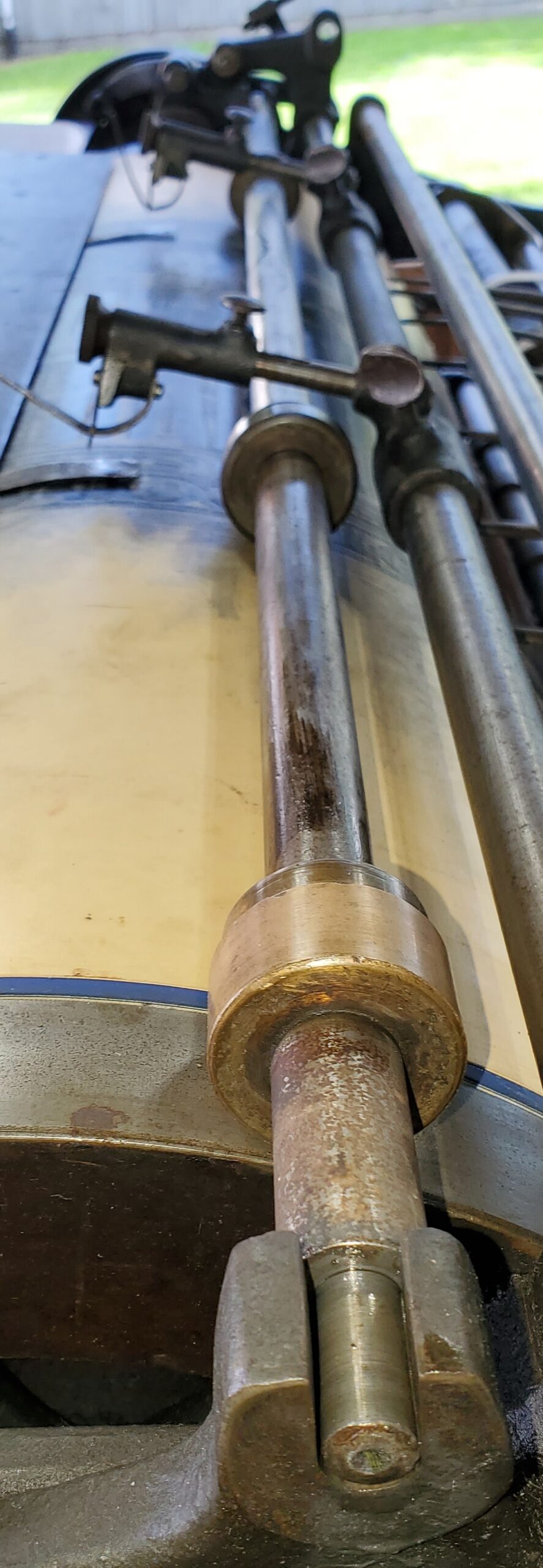 The rollers should be adjusted to run on a non-printing part of the sheet so they do not pick up ink and offset it onto the next sheet. With this roller in place, on delivery the sheet will still be held to the cylinder after the grippers release, and should continue its motion onto the tapes rather than falling back under the weight of the tail of the sheet.
The other shaft (with the rollers and slitter) was installed without the rollers and slitter, instead just providing a support for the lever that operates the sheet lifter fingers. After a bit of adjustment, we had the sheet lifter fingers operating properly. Here are the parts of this mechanism: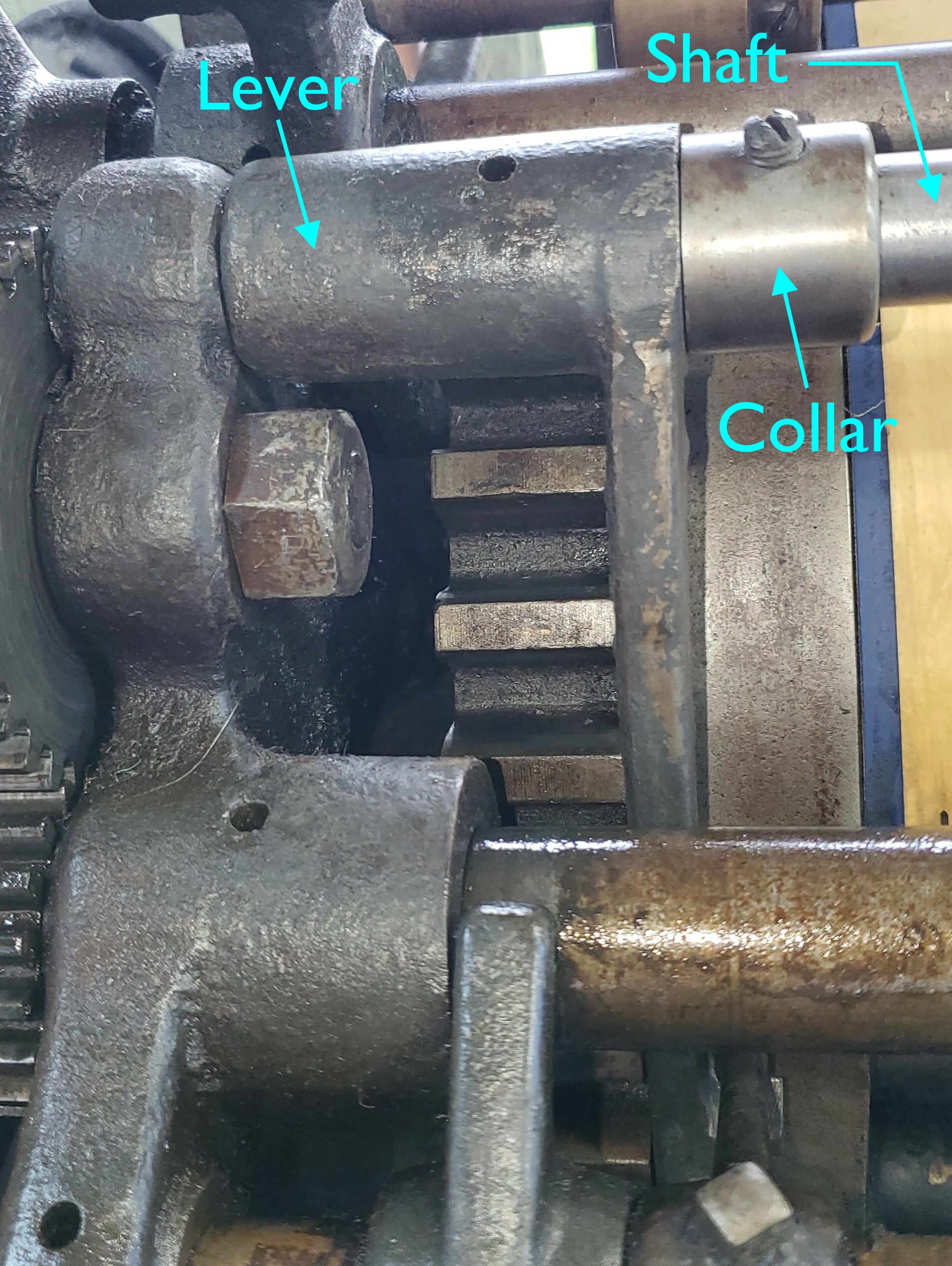 The (new) shaft is fixed in place, the lever is free to pivot on it, and the collar keeps the lever in place. The shaft has a regular bolt at the far end, but at this end it has a slot-head screw recessed in the casting. The idler shaft and gears that operate the tapes had to be removed to access this screw.
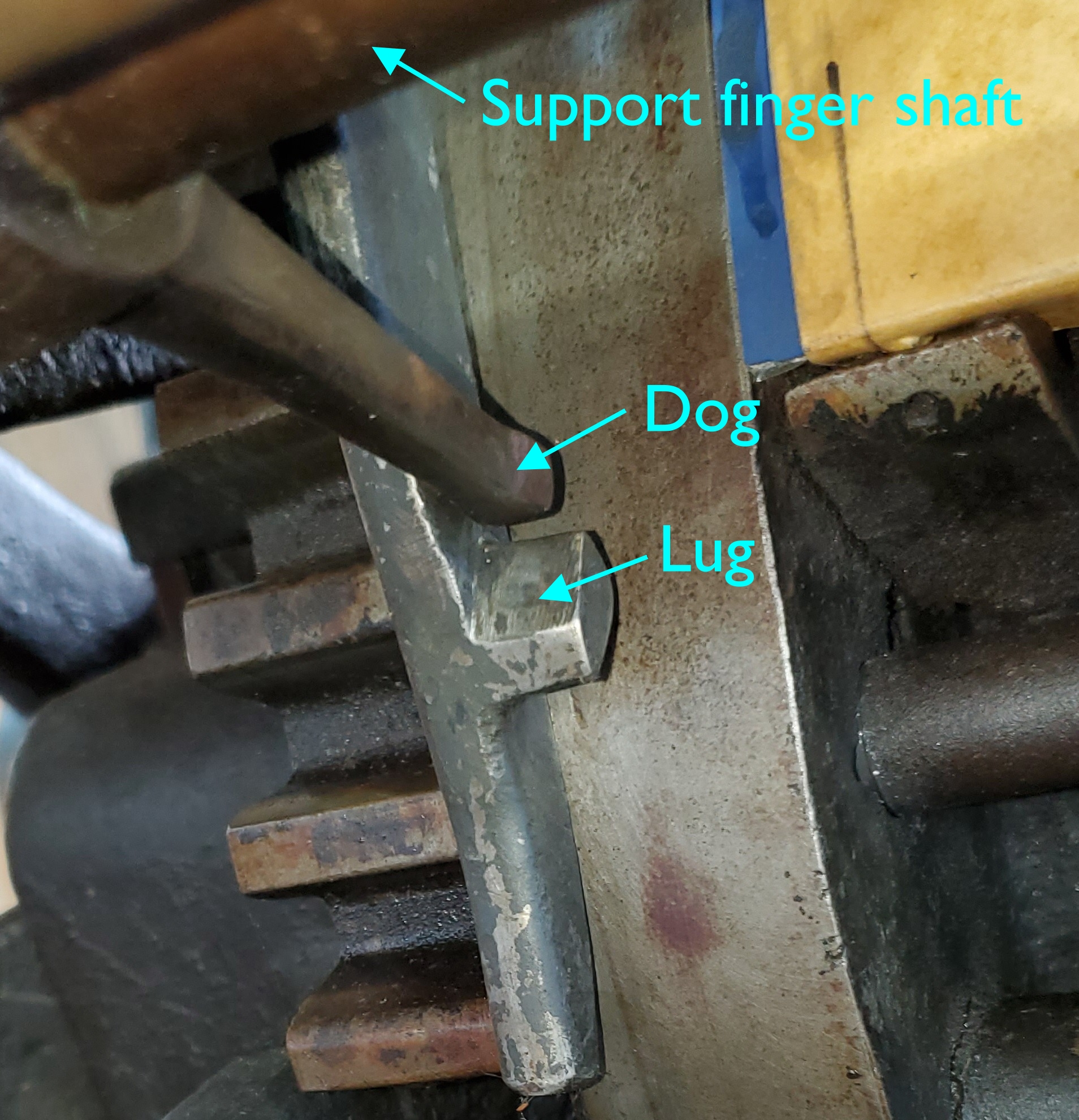 During the feed rotation of the cylinder, the paper support fingers are raised, and a dog on their shaft is also raised as shown here. This means the lever is free to lift away from the cylinder bearer. During the delivery rotation of the cylinder, the paper support fingers, along with this dog, are lowered. The dog prevents the lever from lifting away from the cylinder bearer.
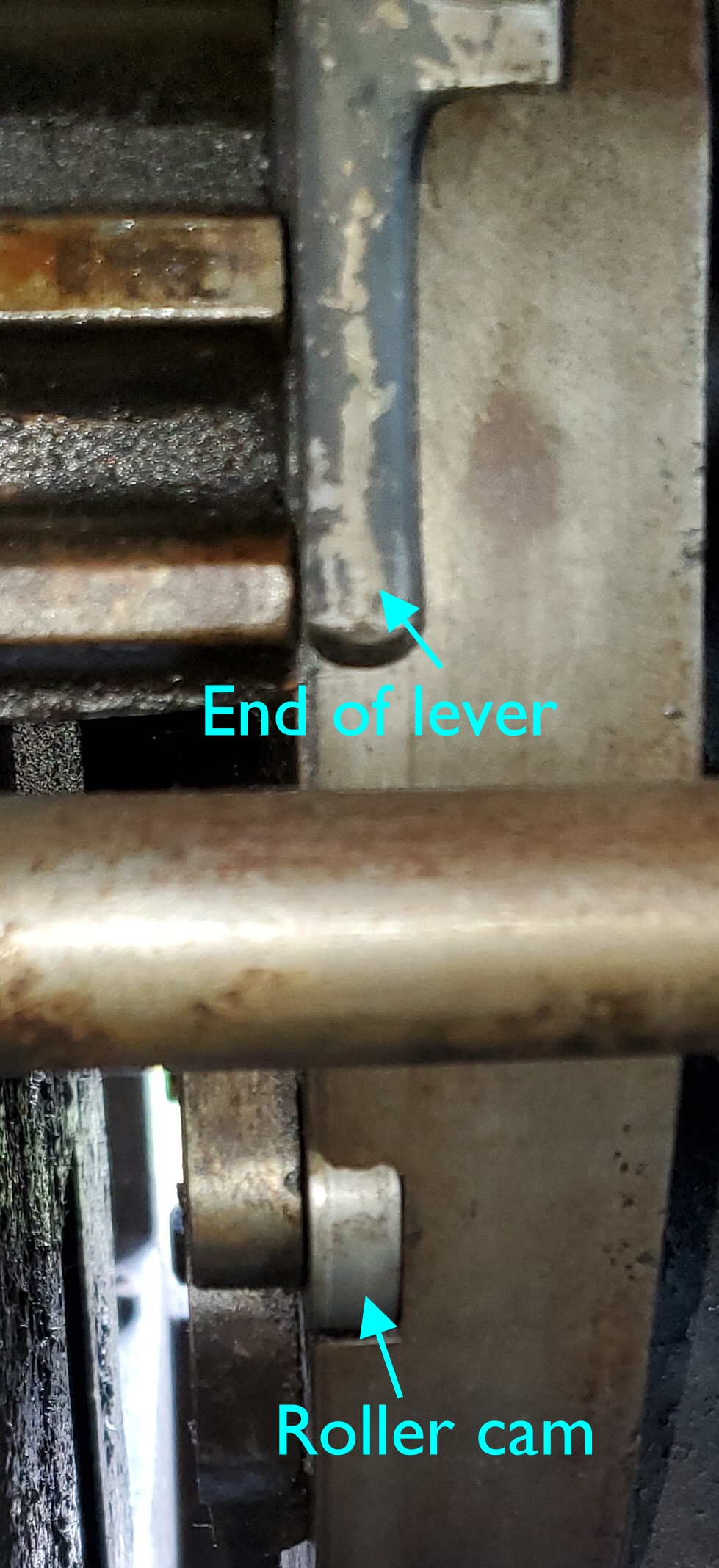 As the roller cam passes under the (immovable) end of the lever, it is pressed into the cylinder, which causes the sheet lifter fingers to rise and lift the edge of the sheet. Because of the positions of the lever and roller cam this happens just after the grippers release the sheet.
The rider rollers were tested a bit. Their placement tends to cause the just-fed sheet to buckle a bit but it looks like it has time to flatten out before it contacts the forme. The buckling seems to be because the sheet is not quite flat to the typman at this point, having been slipped off the fingers of the head guides. By this time the press had been cleaned so we did not actually try printing.
The sheet lifter fingers may still need some adjustment: When they raise up their arc of motion carries them beyond the edge of the sheet. By this point they will have lifted the sheet edge but they may not positively hold it up to carry it over the support fingers. The lifter fingers can be lengthened but if they are too long they can impinge on the printed image. We did not have time to slowly jog the press through this part of the cycle to see if there was positive support of the sheet throughout.
Unfortunately, the larger sheets of newsprint I had brought to test this had been misplaced so I could not actually test if the press could proper deliver such large lightweight sheets.
Leave a Reply