Composition Casting Followup: Type Carrier Repair

While trying to do some composition casting last weekend I found that an internal part of my type carrier was broken, so I had to give this part a quick servicing.

There aren’t actually that many internal parts to deal with, but they go together in a non-obvious manner and if you were not paying careful attention during disassembly you’ll spend forever putting the carrier back together again.

So here is a step-by-step disassembly of the type clamp and type support spring.

Step 1

This shows the type carrier with the back facing up and the top towards the camera. The linkage rods are out of view to the left and were not involved in this procedure.

The first part to remove is the cover, officially called the Type Clamp Shoe. It is held on by three small screws, and has a tang which compresses a spring located under its left end. As you remove the cover be careful to allow the spring to extend in a controlled manner so you don’t lose it. This cover is quite a close fit in its recess so you may have to use a thin knife to lift it out. Start lifting at the right-hand end.

Step 2

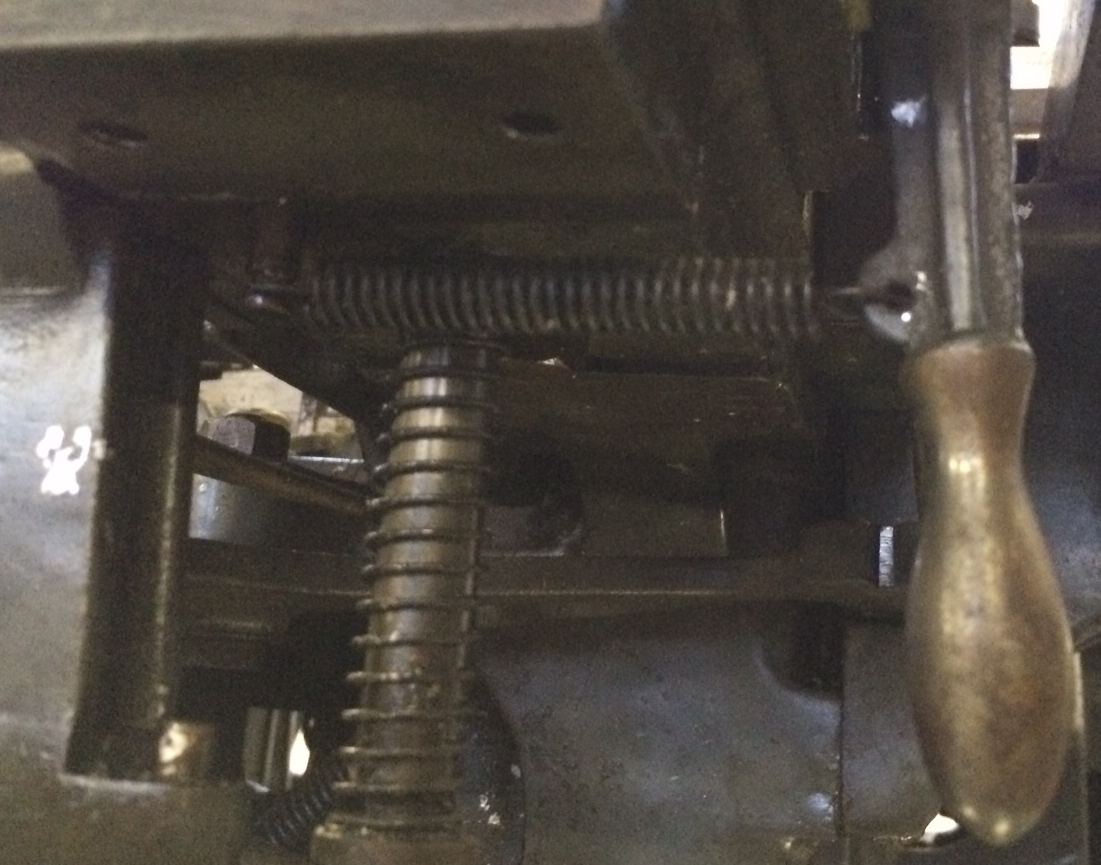
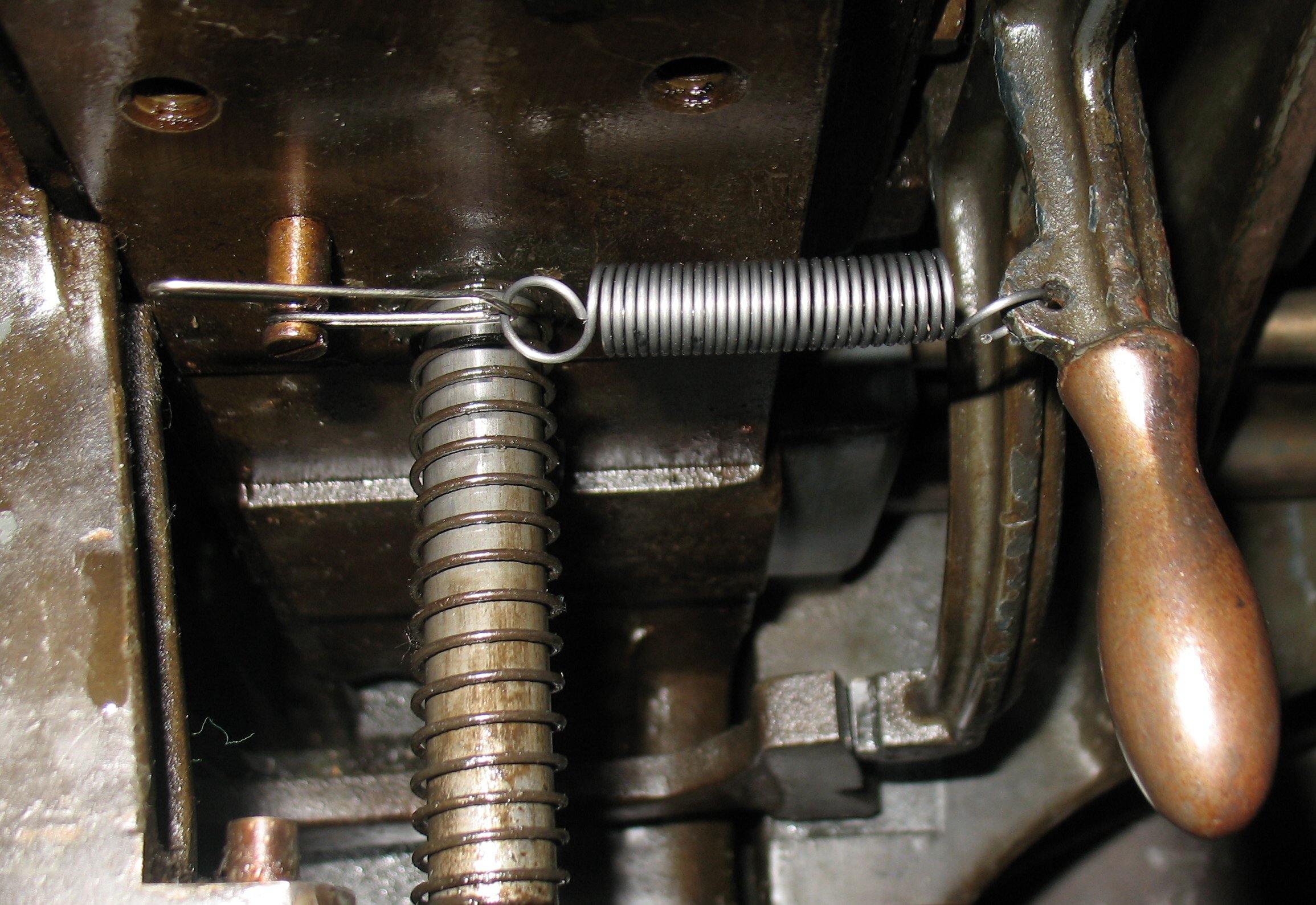
With the shoe off, most of the internal parts are at least partly visible. The type clamp is held closed by its spring a26B2 which in turn was compressed by the tang at the left end of the shoe. The Type Support Spring runs mostly under the Type Clamp but there is a small protrusion on the Type Clamp which is behind the Type Support Spring. This protrusion is what the lever presses against to open the clamp.

To remove the Type Clamp, use your left hand to gently hold the Type Support Spring and its associated parts in place while you use your right hand to lift out the Type Clamp. The support spring will start to come up with the clamp, but once the clamp is completely out of its groove it can be pivoted up and twisted to release it from the type support spring. The Type Clamp Spring and its guide rod should be removed if they did not come out with the clamp.

Step 3

The Type Support Spring and its Bar Yoke are tenuously attached to each other but it should be possible to remove them as a single unit by just lifting them out.

Step 4

These parts are only held together by a small contact area. If this spot is worn and no longer has nice sharp corners, the pieces will tend to fall apart and, if you are not careful, may shoot across the room. The Type Support Spring is moved back and forth by the lug on the lever engaging in the spot as marked by the dashed arrow.

Step 5

The Type Support Spring comes apart into the parts shown above. When assembled, the left end of f31B1 snags on the boss on c31B4 and is held against this by pressure from the spring. In use, if something is blocking the support spring from advancing towards the end of the type carrier, the spring compresses and only c31B4 moves.

IMG_6895This shows the two damaged parts in my type carrier, with new (or perhaps like-new) replacements above them.

The prongs on the type clamp are splayed outwards and (although it does not show in the photo) also bent back.

The end of the type support spring is still bent out of shape, despite my attempts to straighten it, and is also missing its tip.

After cleaning all the parts, I reassembled the type carrier with the new type support spring, but I was unable to get the new type clamp to move smoothly so I bent the prongs on the old one back into shape as best I could and re-installed it.

I have two or three other type carriers in my spares so I may try mixing and matching type clamps to see how their fit varies. The parts manual does not contain anything implying that these would need to be specially fitted.

Once I reinstalled the repaired type carrier in my caster all the type started arriving in the type channel oriented correctly—no more sideways spaces! Unfortunately I still don’t know what actually happened to damage the support spring in the first place, and I only have a few more spares.

Composition Casting Followup: Nozzle Problems

During this weekend’s attempts at composition casting I had problems with type metal flow, both flowing where I don’t want it, and not flowing where I do want it.

I had many problems with nozzle freeze. On each casting cycle, the nozzle, which is the outlet of the metal pump, rises to seal against the opening on the underside of the mould, the pump stroke occurs, and the nozzle drops down again. The nozzle is heated by conduction from the molten metal in the pot, and also by the molten metal that pumps through it. It is cooled somewhat by radiation and air convection, but primarily by its periodic contact with the mould. The nozzle movement is adjusted to minimize the time it spends seated in the mould while still sealing against any pump pressure that might exist.

A nozzle freeze occurs when the metal in the nozzle solidifies before the mould is full and fails to melt again before the next casting cycle. At that point, there is no metal flow to heat the nozzle and the temperature drops quite a bit. The immediate cure is to turn off the pump so the nozzle can thaw again by heat conduction from the metal in the pot. Needless to say, at this point the cast line has lost some types.

Things that make nozzle freeze more likely are:

  • Maladjustment of the seating time keeping the nozzle against the mould longer than it needs to
  • Maladjustment of the pump stroke timing delaying the initial flow of metal
  • Insufficiently hot metal in the pot
  • Mould too cold
  • Casting speed too slow
  • Casting too many small (narrow) types

Converse problems which can happen include leakage around the nozzle when the pump stroke occurs while the nozzle is not properly seated, deformations of the type body if the metal in the mould cavity had not solidified quickly enough, or mould damage or incorrect type dimensions caused by the mould overheating.

Leakage around the nozzle is caused by:

  • Maladjustment of the seating time not keeping the nozzle against the mould long enough
  • Maladjustment of the pump stroke timing making the initial flow of metal too early in the cycle

Deformed type and signs of mould overheating are caused by:

  • Too high a temperature of metal in the pot
  • Mould too hot
  • Casting speed too high
  • Casting too many wide types (Em quads)

As you can see there is a balancing act between these two limits. Controlling mould temperature in particular requires ongoing monitoring of the cooling water, plus remembering to turn it on and off when the casting is started and stopped. At least the pot temperature and casting speed are regulated…

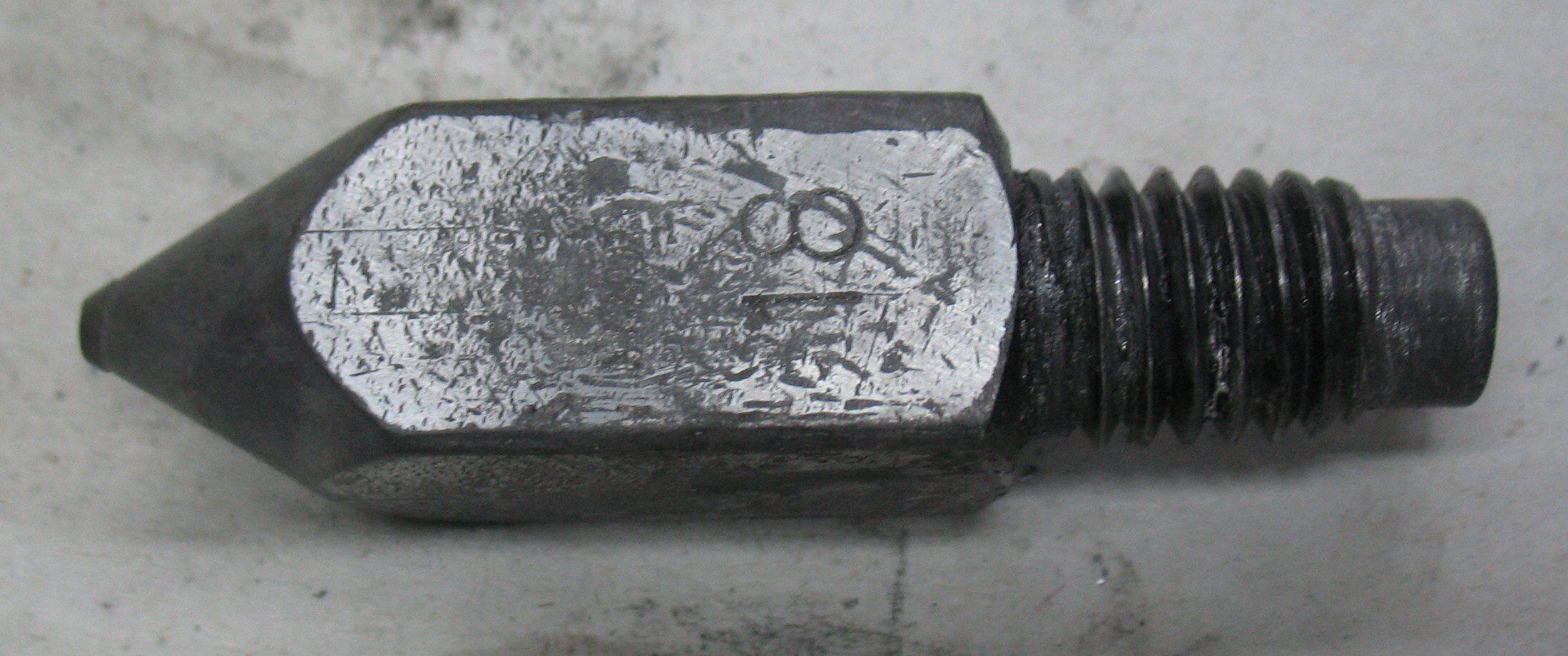
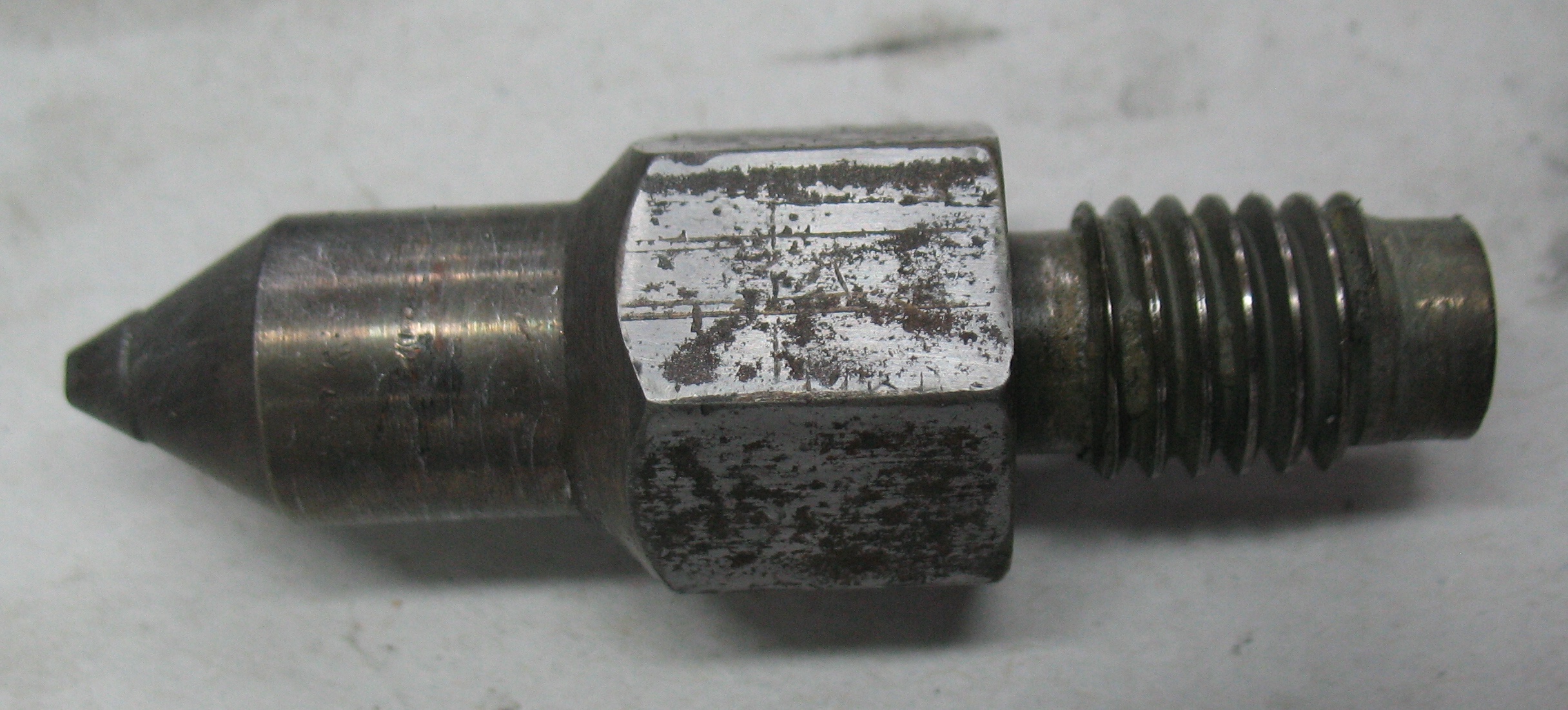
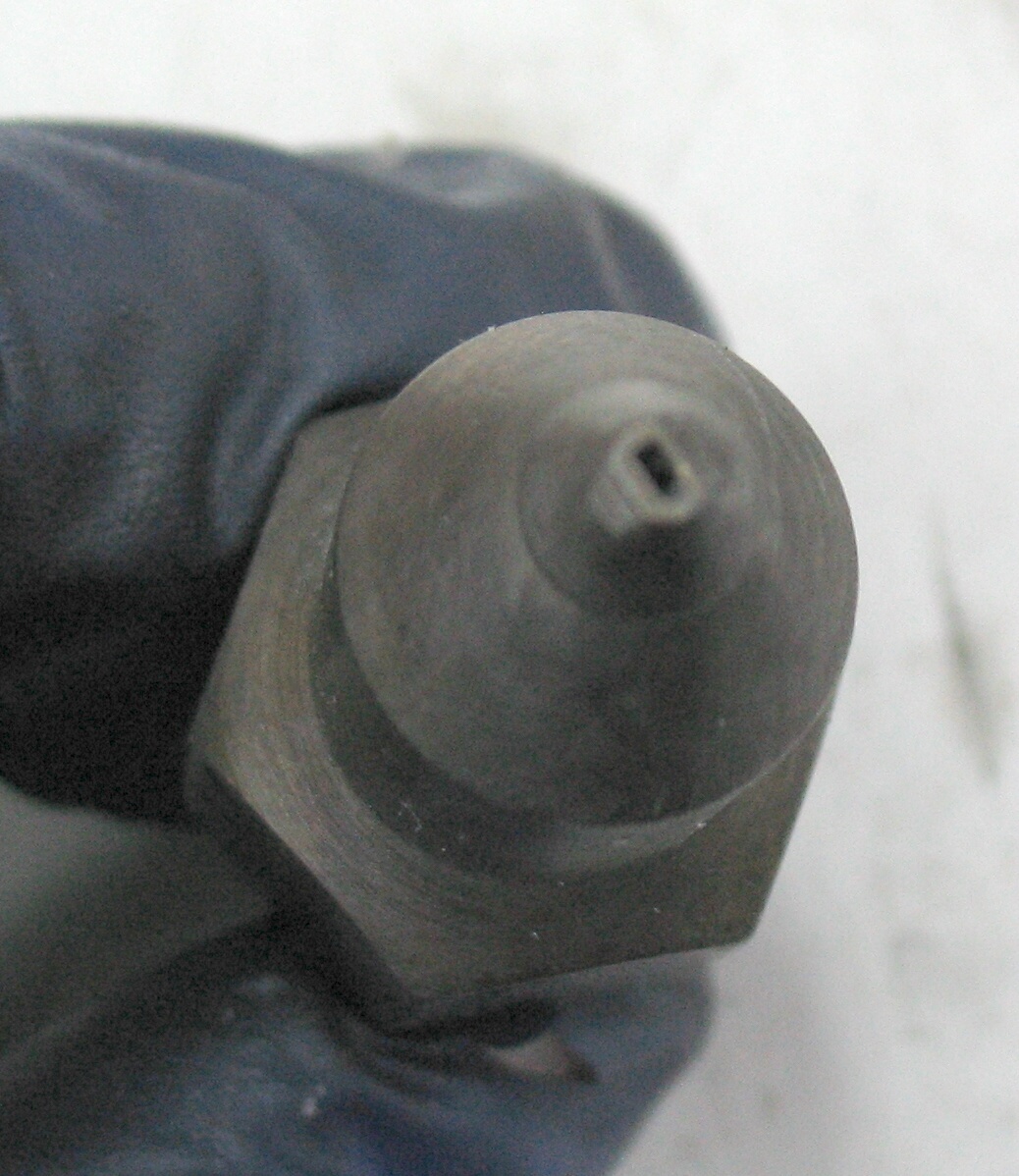
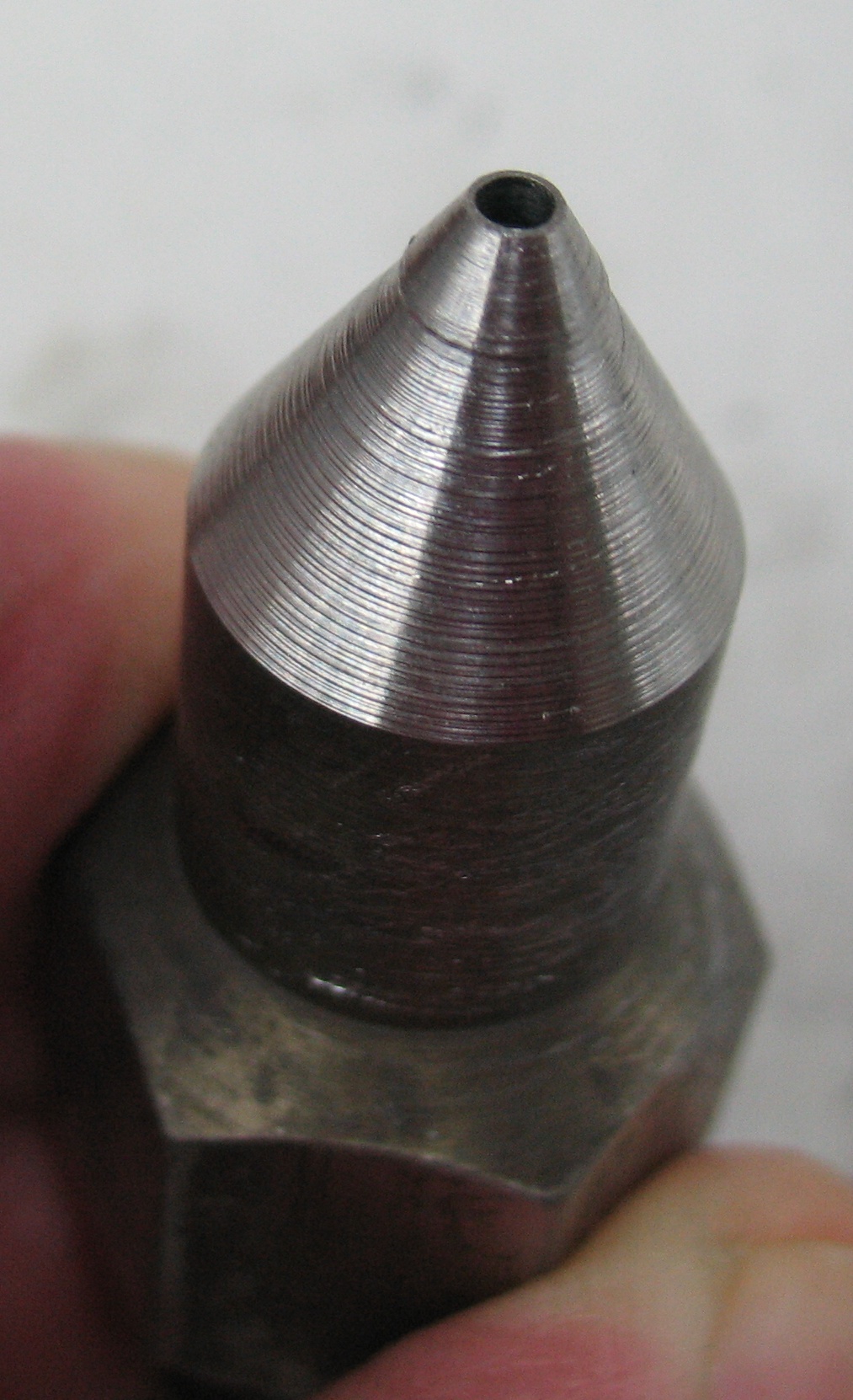
One thing Monotype did to help with freezing was to introduce nozzles made from stainless steel, which has only about half the thermal conductivity of regular steel. Although this means the nozzle gets less heat from the pot, it also means it loses less heat to the mould. Unfortunately I don’t have one of these, although I have the shop drawings and could make one if I felt I really needed it.

IMG_6887During my casting efforts on Saturday it was clear that the nozzle and pump timing were off because I was getting huge deposits of hardened type metal under the table around the nozzle. The photo shows one of these lumps once I had pried it out. Near the center top of this lump you can sort of see the shape of the cone hole on the underside of the table. At the point I removed this the lump was bulky enough that it hung on to the nozzle as I cranked the pot down to clean up.

On Sunday I got the nozzle and pump timing adjusted so these nozzle leaks did not occur, but then I was confronted with constant nozzle freezes. I eventually got the caster to run without freezes by raising the pot temperature to 690°F (which I think it pretty high for Linotype alloy), running it at 120RPM, and keeping the cooling water off completely.

Although I managed to finish the casting (only about 12 lines), I had several signs that the mould was running very hot. One was that, after ending the casting run I ran some cooling water and the water leaving the mould circuit was steaming hot.

Jet Vent Tomahawks

Another is that the air vent added to the mould by Hartzell was filling completely with metal and in fact spurting out a bit of metal.

I mentioned this vent while describing the mould refurbishing, and this photo shows the tomahawk-shaped jets that are formed. The red arrows point to the area where molten metal was spurting out. Normally the metal should harden partway along its flow through this channel.

There is also quite a bit of flash on these, indicating that there is some excess clearance in this part of the mould (where the bottom plates of the crossblock press against the squaring block).

Tomahawk SpitWhen running the caster I kept thinking I was seeing things, like a little shiny drop squirting from the side of the mould, but could not see it when I looked directly at the area. But when I was done I found that all the squirts were landing on part of the pump supports, as indicated by the red arrow in this photo.


So far, before another casting run, my action items include:

  • Review recommended metal temperature and casting speed for this alloy and body size
  • Check mould crossblock for contamination during reassembly


It Speaks! Well, mumbles, anyway…

I spent the weekend trying to do some composition casting on my Monotype caster, using the ribbon I had keypunched while I was at Mono U 8 last summer. By Sunday evening I had something I could take a proof of, but there is still plenty to do. I knew I would not have a good forme of type because I was casting the type to a different set size that the ribbon was punched for (I did not have the correct wedge), which guarantees that the line lengths will be all wrong.

Through Saturday afternoon I had the caster reading the ribbon and casting short bits of the text, but I had plenty of problems.

One is that I was getting large amounts of type metal collecting around the nozzle under the caster table. I thought I had adjusted the nozzle seating timing properly but this persisted, forcing me to stop the machine every dozen lines or so, lower the pot, and pry out the lump of hardened metal.

I also had problems with the transfer of the type from the mould to the type channel. While casting low quads, things seemed to be running fine for a dozen casts or so, then I would hear a clunk and a badly damaged quad would appear in the type channel. The type appeared to have been smashed by the type clamp, or perhaps by the type pusher while pushing it into the type channel. Ofter the foot and/or head would be sheared off, and often this would jam the type channel, forcing me to stop casting and clear the type channel.

The type support (which is a spring arm that catches the type as the mould blade ejects it) appeared a bit distorted and seemed to be leaving a mark on the end of the mould blade as well. The problem was more frequent at higher caster speeds. One thing I tried was to disable the type support, and this seemed to make the problem go away but I could not really explain why.

As the afternoon wore on, the casting seemed to start to work better, probably as the machine warmed up overall. Things seemed to be going not too bad, except that narrow spaces were turned sideways in the type channel. A closer look at things revealed that they were sideways in the type clamp as well. As it turns out, I still had the type support disabled, and this allowed narrow types to turn sideways before the type clamp could grab them. Turning the type support on gave back the properly-oriented narrow types.

By this point, though, my ribbon had become damaged enough to jam in the paper tower. Actually, it did a neat trick: it managed to come off the sprocket holes and shift sideways by about 1/8″ but still run straight and advance properly. Because all the punch holes were off by one position this made for some pretty random casting!

By then it was time to call it a day.

Sunday afternoon started with repairing the damaged ribbon. It turns out that the areas that I had repaired using PVA glue were quite brittle and prone to cracking. This time I used Scotch Tape to repair the tractor holes. Where there were few punch holes near the edge of the ribbon I applied the tape half over the edge of the ribbon and folded it over the edge to tape both sides with one piece of tape. If there were many punch holes near the edge I would apply one strip of tape on one side, just clearing the punch holes and hanging over the edge of the ribbon, then apply another piece of tape similarly on the other face of the ribbon. I would then trim the excess tape using a rolling cutter. In either case I would use a small home-made hole punch to re-punch the tractor holes and also any punch holes I might have blocked.

Back at the caster I repeated the nozzle seating adjustment, and also re-checked the nuts on the underside of the swing frame that determine exactly when, in the stroke of the pump cam, the pump actually starts to pump metal.

Once that was done I was back to casting quads. And back to the nozzle freezing after casting only a few quads. Eventually by speeding the caster up to 120RPM, running the pot at 690°F, and running no cooling water, I got the machine to cast quads apparently indefinitely.

So I started the ribbon up again. It seemed to be casting all right, but I was once again getting turned narrow spaces in the type channel. Using a flashlight I had a look at the type carrier action, and saw that the type support was badly bent, preventing it from doing its job. I removed the matcase and bridge so I could verify that the type support was bent, and it was. I removed the type carrier and replaced the type support with a spare I have. I also wanted to replace the type clamp (which was also bent) but the replacement part did not move smoothly, so instead I did as best I could to bend the type clamp back into shape and replaced it in the type carrier.

While the bridge was off I also checked the crossblock on the mould and since it seemed a bit loose, I tightened it up a bit.

I reinstalled the type carrier on the caster, along with the bridge and matcase and gave things a try. I was rewarded with an unusual squirt of type metal. As it turns out, while diagnosing the type carrier problem I had removed the coupling block that connects the type carrier to the mould cross block. When I tried casting the front face of the mould cavity was completely open, hence the squirt. The good news is that the squirt was confined to a small area to clean up. The bad news was that it was the opening that the mould crossblock slides in.

Once that was cleaned up I got back to casting again. While I was fixing the type carrier, the pot was swung out so the mould and caster table had cooled down, and I was back to having nozzle freezes. I just wanted to bulldoze my way through by then so I just kept an eye on things; when the nozzle froze I would stop the ribbon, turn off the pump, and wait a moment. Then I would turn on the pump again and turn on the ribbon feed. Generally casting would resume and I would get the line with a few types missing.

At one point, though, the caster just stopped. I had my hearing protectors on, and the compressor was running, so it took me a while to figure out that the motor was stopped. The overcurrent sensor in the magnetic starter had tripped. The motor itself did not seem hot, so I think I have to adjust the current limit setting.

I finally managed to fight my way through one run of the ribbon. The type was badly pied because the line lengths were all wrong, but I had cast the ribbon and it was time for dinner.

I cast it all. Waddaya mean you want the type in neat lines?

I cast it all. Waddaya mean you want the type in neat lines?

After dinner, I repeated the exercise with better results. I turned off the wrong-line-length detection and cast the ribbon with only one incident. The motor overcurrent tripped again on me, but this time I just waited for it to reset and restarted the caster. After each line was delivered do the galley I used quads to fill it in a bit.

Happy now?

Happy now?

Since this post is already TL;DR I’ll follow up in the next couple of posts.

Monotype Mould Signalling Lever

Mould Signalling LeverThe Monotype caster has a small lever which is used to control the opening of the upper mould blade to produce low spaces. This lever is actuated by an arm that descends from the bridge, which in turn is controlled by the presence of a mat with a shallow cone hole.

An alternative version of this lever is straight, and is used with an English bridge and American moulds.

I had been trying for ages to get this lever off my caster (as evidenced by the mangled screw head on its pivot) but with no success.

As I found out on last summer from looking at Rich Hopkins’ casters at Mono U 8 this pivot pin has no head. The lever should just lift off it!

So a few weeks ago when I had a bit of time to spare, I tried once again to remove it. With its spring, spring post, and the mould removed the lever should be clear to lift off. The damage to the top of the pin from by previous removal attempts might cause a bit of trouble, though.

I sprayed some solvent onto the pivot pin, and gradually managed to work it up, first getting a putty knife under it, then a small screwdriver, followed by larger ones. Finally the arm popped off, and it appears that it was just dirt and hardened oil that was holding it on. Once I cleaned the lever and post and re-oiled things it slipped on and off easily, although it is necessary to turn it to just the right position partway up to clear other parts. It also turns easier now.

While I was working on this I also closed up the loops at the ends of the spring so it would not accidentally fall off and end up on the floor. This happened to me once here and also happened to us several times at Mono U.

The pivot pin itself is still seized in the table, but that should not be a moving part anyway.

This puts me one step closer to using my English bridge should I choose to do so.

Cleaning the “Scissors” on a Monotype Display Mould

While waiting for other things to resolve themselves, I set out to clean the display mould that I has last used on my Monotype caster. This particular mould is an English-style display mould, which uses replaceable inserts to change body size.

InstalledBoth these and the American-style display moulds use a pair of levers which vaguely resemble a pair of scissors to control the upper mould blade. In normal usage, a spring box is positioned between the “handles” of the scissors to push them apart, which forces the upper mould blade to open in unison with the lower blade, for casting normal type. For casting low quads, the spring box is swung around to press against the mould oiler fitting, thus forcing the upper blade closed at all times.

The spring box on this mould had become seized, with the plunger stuck in and no spring action, so I disassembled it to clean and lube it. A rivet holds this together, so I had to carefully file the head and peened end so the rivet could be driven out.

The rivet and arm were now out but the plunger was still stuck. Fortunately there was just enough of the plunger showing through the arm slots that I could grip it gently with a pair of wire end-cutters and work it out. The spring then came out as well, with a cake of oily rust covering about two of its turns.

The plunger, spring, home-made rivet, and tube, all shown below one of the arms.

The plunger, spring, home-made rivet, and tube, all shown below one of the arms.

I cleaned the parts first with solvent, then with a soak in Evapo-Rust. I also felt that it should be possible to oil these properly so I added an oil hole to the tube. Either this is very hard steel or I had the misfortune to try the two dullest drill bits in my shop, but I was unable to drill a hole. Instead I used an abrasive cutting disk on my Dremel to cut a groove that penetrated to the inside of the tube.

I made a replacement rivet on my lathe, reassembled everything, and finished putting the cleaned mould together. The photo of the mould, above, is actually an “after” photo where the oil hole I added can be seen.

The spring box and lever arm ends viewed from the underside of the mould

The spring box and lever arm ends viewed from the underside of the mould. This shows the peened end of the rivet.

Unclogging Cooling Passages in a Monotype Mould

After installing my refurbished 10-point mould on my caster I tested the cooling water flow and found that the flow through the mould itself (rather than just the cooling passages in the table) was inadequate.

I know from when I had the mould in pieces that the water passages had been plugged completely with rust. I managed to clear them at least somewhat using a piece of stiff wire—the end left by the wire cutters proved to be good for drilling through the rust. However, not all the passages in the squaring plate could be cleared this way since they were not straight, and the plugs sealing off each straight section could not be removed.

ToolIt turns out there is a tool for clearing these water passages by forcing fluid through them with much more pressure that the cooling piping supplies. This tool is bolted to the underside of the mould and connects the two coolant ports on the mould to the two open brass tubes on the tool.

The piston (at the center of the picture) is a close fit in the brass tubes and can be used to force fluid through the cooling passages of the mould.

This particular version seems to have been mass-produced, as I know Rich Hopkins has several of them (I got mine from him). However, I also have a much cruder one which appears to be someone’s attempt to make their own.

Mould with tool installed with extracted dirtThe second photo shows the tool mounted on the mould. The mould itself is upside down on a piece of triple-wall corrugated cardboard to protect its top surface.

The paper towels in the photo show some of the dirt and rust I extracted.

The first fluid I used was some Evapo-Rust, which would to some extent dissolve the rust and loosen more of it. This seemed to flow fairly well, but it was still clearly loosening some rust.

After draining the Evapo-Rust I switched to heavy lubricating oil, which could generate more internal drag to break away more rust.

After a couple of passes with oil, I did two more passes with odourless paint thinner to clear out the rust-laden oil.

I re-installed the mould on the caster and tested the water flow again. I was still having trouble getting flow through the mould. Thinking the piping might be blocked somewhere, I removed one of the plug screws from the water fitting on the side of the table. The screw I removed was the one closest to the front of the machine, which lines up with the outlet of the mould cooling loop. A couple of seconds after removing this screw, water started to flow from its hole, so I put the screw back in place.

I now had water flowing through the mould. Perhaps the narrow oily water passages were sufficiently hydrophobic to prevent the water flow from starting. Essentially the water was being held back by its own surface tension.

So I think I have everything ready to go now. Except that the handle has fallen off the ball valve I installed on the water line…

Tagged with:

A Mess Delays Work

The snow plow that I use to clear the driveway here stopped working. The winch which raises the blade stopped running, and since it seemed to be related to the cold weather (and heating the unit appeared to fix it temporarily) I figured there must be ice in the gearbox or motor housing. Opening up the gear box revealed nothing suspect, but even with the gears removed I had trouble turning the output shaft of the motor.

I reassembled the gearbox, then took the motor casing apart. This is a permanent magnet motor, and at least one of the magnets had come loose and was clinging to the armature. Every time the motor turned some of the face of this magnet would get ground off. The banging around each time the motor reversed also chipped and cracked the other magnets, so the motor was filled with black dust and crumbs in a whole range of sizes. The real problem, though, was that this was magnetic dust (and probably a good abrasive), and I was using the same workbench area I was using to refurbish a Monotype mould. I was certainly not expecting this sort of mess to come out of this motor.

Magnetic Mess

You can see a crossblock and other mould parts near the back edge of the paper table cover, and some of the magnets coated with a fur of dust just in front of the motor casing.

I spent part of this evening carefully picking up each tool, wiping off most of the dust, using adhesive tape to pull off the rest, and putting the cleaned tool aside. I did the same for the mould parts. I bagged all the parts of the motor in Ziploc bags and put them aside. The paper table cover was carefully folded over with all the dirty towels and tape inside and tossed in the trash. I wiped down the tabletop a couple of times and replaced the paper table cover.

Now, with a clean work area, I went over the mould parts again for any remnants of the dust. The motor can perhaps be repaired by gluing the magnets back in, but that is a summer job, when I can work outside and not have to worry about the dust. For now I am replacing the entire winch on the plow.

More Monotype Mould Measurements

After doing some R&R on one of my Monotype composition moulds I found that when installed on the caster, the type carrier could not reach into the mould without rubbing on the face of the left type block. One of the assembly steps for this style of mould does not have any reference points to replace a part in the exact location required.

I set out to measure all my moulds to determine what the correct distance is between the faces of the left and right type blocks and the read edge of the mould’s base plate. For the 3E style moulds I also measured from the faces of the type blocks to the rear of the squaring plate to see if that was consistent from one mould to another. If it were, a simple spacer could be used to properly install the squaring block in the right position.

The first measurement is an awkward one to make because the two faces are not back-to-back. I eventually found that a metal angle clamped to a flat surface could be used to do this. The back edge of the mould base would be held against the edge of the angle, then measurements taken from the upright leg of the angle to the face of the type block. I used a piece of 2″ aluminum angle bar, so my measurements were 2″ greater than the actual distance I wanted to measure.

Measurement on an English composition mould using a 4″ micrometer.

Measurement on an English composition mould using a 4″ micrometer.

The distance I found was pretty consistent across the six moulds I measured: the average was 1.940″ and the maximum was 1.946″ whereas I found the distance to be around 1.96″ when I measured the refurbished mould.

I loosened the screws on the underside of this mould (5 holding the squaring plate and 5 more holding the type blocks) so the inner assembly could move around. The type blocks were still held to the squaring plate by 5 other screws in the ends and back. I set two of the screws to provide just a bit of friction, placed the mould in my measuring setup and tapped the parts until they showed an acceptable distance. Then I tightened all the screws again and made a final measurement of 1.938 inches, a bit low, but within the range of my other moulds.

I reinstalled the mould on my caster, and now the type carrier moved freely. I used a feeler gauge to measure how much clearance the type carrier had, and the result was 0.013″ which would imply a maximum distance of 1.951 inches would be acceptable.

The other distance of interest, from the face of the type blocks to the rear of the bosses on the squaring plate, at least initially seems disappointingly inconsistent and so not useful as a reference for mould reassembly. One problem though is that I was making these measurements on assembled moulds and this makes accurate measurement difficult. As well, the rear surface behind the right type block may not be precision machined but the surface behind the left type block is precisely machined, so I will have to take a closer look at this idea next time I take a mould apart.

I also did a check for water flow through the mould and that is still insufficient, as it is only a drop or two per second. I will have to take the mould off again and try blasting fluid through the cooling passages to try to clear out any blockages.

A New (to us) Press

Last Friday we picked up our newest press, a Challenge MA15 Proof Press S/N 5338. This model was a copy of the popular Vandercook SP15 press, which Challenge eventually had to stop selling because of issues of patent infringement.

ArrivalWe moved it on an open trailer, but it was so cold that morning we didn’t have to worry about salt spray off the roads. We pallet-wrapped the top of the press to keep stray snow off it and strapped it down in a rental trailer (my own trailer is trapped in the snow). We moved it from Paris, Ontario (about 15 minutes away) with no incidents and unloaded it from the trailer right into our shop.

The crank handle and the form, oscillator, and rider rollers had been removed for the trip. Once the press warmed up again I unwrapped it and reinstalled all these parts.

Unwrapped and assembled, all ready to print. But it needs to be moved first...

Unwrapped and assembled, all ready to print. But it needs to be moved first…

Monotype Mould Final Reassembly

With the crossblock and blade reassembled, the rest of the mould goes together quickly. All of the remaining parts are built onto the base plate.

Squaring Plate and Cam InstalledThe first parts to go on are the cam which operates the jet ejector as the crossblock moves sideways, and the squaring plate on which the parts forming the mould cavity are built. The cam is positioned by two dowels which I did not remove from the base, and secured by two screws inserted from the underside of the base plate. The squaring plate is held by five screws from the underside of the base plate and does not have anything to provide positive positioning. I set it in about the middle of the play provided by its screw holes, but as I later found out its position is more critical than I had thought.


Type Blocks and Blade InstalledThe next parts to install are the left and right type blocks. The larger right block (on the left in the photo) also has two plug screws for oil passages and two felt pads to meter out the oil, which I installed into the block beforehand.

Each of these blocks has screws securing it against the squaring plate in three dimensions: one at the outer end pushing the two blocks towards each other, one or two through the boss of the squaring block to pull the type block back, and one or two from below through the base plate to hold the type block down.

As with the screws in the crossblock, these must be tightened gradually in sequence to ensure the type block is seated properly.

If all goes well, at this point, the mould blade can be inserted by sliding it in from the back. In my case, one of the felt pads (the one that oils the side of the blade) was not fully into its hole, so the blade actually had to shear off some of the fibres from the felt. As a result the initial insertion was tight, but it quickly loosened up as the sheared-off fibres worked out of the sliding area.

Blade Guides InstalledThree small parts that retain and guide the blade are installed next. The are the right mould blade shoe which holds the main blade down and limits how far it can open, the mould blade stop which limits how far the mould blade can close, and the mould blade carrier guide block which prevents the back end of the blade from moving sideways. The back surface of the mould blade stop has been precision ground at the factory so the mould blade, when closed, is exactly flush with the front faces of the two type blocks. At this point I also dropped the upper blade operating lever into place on its pin on the blade carrier.

Covers InstalledThe two covers are installed next. The left cover (the one with four screws) is also called the left mould blade shoe because it completes the guide that the blade slides in. It both holds the upper blade down and also prevents it from shifting to the left. The right cover (the one with two screws; the apparent third screw is actually the one holding the right mould blade shoe in place) is also called the mould blade top guide as it prevents the blade from shifting to the right.

The last part to assemble and install is the apron, or front abutment. It includes the nameplate and the crossblock shoe along with its adjusting screws and locknuts. It is held to the base plate by three large screws from below.

Complete Front ViewI slid the crossblock into place, and as with the mold blade, the felt pad (the one on the crossblock) was not tucked back into its hole neatly. However, in this case I could reach the pad to tuck it into its cavity as the block slid in. I slid the block to the position in the photo and tightened both shoe adjusting screws tight and left them that way for a while to seat the felt.

Later (after taking the photo) I backed off the adjusting screws a tiny bit (less that a tenth of a turn) and tightened their locknuts.

Everything moved freely and was now well oiled so I put the mould in place on the caster (using only the two clamps, not the blots from below). On turning the caster handwheel by hand I found to my dismay that the caster would not operate smoothly. The type carrier appears to be rubbing on the front face of the left type block.

Some thought on which parts mount where leads to the conclusion that this interference is caused by incorrect placement of the squaring block. Evidently on factory assembly these are installed using some sort of fixture to hold the squaring block at the right location on the base plate.

To correct this I don’t have to disassemble everything; I should just be able to loosen the eight screws that hold the squaring block and type blocks to the base plate. Before doing this, though, I will have to measure some other moulds to determine how far the type block fronts should be from the rear edge of the base plate. If they are too far the type carrier will rub the type block as I observed. If they are too close the type carrier will fail to pick up very narrow pieces of type as they eject from the mould cavity.

The next post should include the results of these measurements and the correction of this mould’s squaring block position.

Top