Cleaning and refilling the Monotype pot

For the casting job I have coming up I want to use Monotype medium alloy (74/10/16% Pb/Sn/Sb) rather than the softer Linotype alloy (84/4/12%) currently in the pot, which I was using to cast spacing.

To do this, I got four ingot moulds ready on a cart, mostly covered by galley trays to protect against any pops and splashing that might occur if the hot metal finds some moisture trapped in the surface of the mould.

I fired up the pot, and once it was well melted I removed the pump, fluxed and cleaned the surface, turned off the heat, and ladled the type metal into the ingot moulds. As I neared the bottom of the pot I had to switch to progressively smaller ladles, and left a small puddle of metal in the well in the bottom of the pot. While things were still hot, I also used a screwdriver to loosen some of the mush that was stuck between the heating elements and the walls of the pot. This mush is a mix of molten metal and oxides which contains enough oxide powder that it doesn’t just flow to the bottom of the pot.

Once the pot was cold again I scooped out most of the loosened mush (now hard again because the metal holding it together had solidified) and pulled out the disk of metal hardened in the well.

The cart holding the moulds wasn’t level so one of the moulds overflowed into the cart. The galley pans covering things meant I didn’t see this happening. In any case, I ended up with four ingots, one puddle from the spillage and the disk from the well.

02 - Metal Removed 01 - Empty

To do a better job of removing more of the hardened mush around the element, I removed the pump support arms which otherwise block access to the rear element and the area near the electrical connections.

All cleaned out and the pump supports re-installed. I was tempted to vacuum out the rest of the dust but decided that anything loose enough to vacuum would also be loose enough to float to the top when the pot was refilled.

All cleaned out and the pump supports re-installed. I was tempted to vacuum out the rest of the dust but decided that anything loose enough to vacuum would also be loose enough to float to the top when the pot was refilled.

One ongoing problem I have had with my pot is that the end of the front element, where it wraps around the nozzle area of the pot, is too high. To keep it submerged I have to keep the pot absolutely brimfull with metal, which makes for more frequent spills, and also makes fluxing and cleaning the metal more difficult. Running with a lower metal level in the pot, leaving part of the element exposed, creates a hot spot in the element where it might burn out prematurely, and forms an extra-hot surface exposed to the air which encourages faster oxidation of the metal.

To force this part of the element down, I put a small piece of 1/8″-thick steel under the nearest retainer clip, which pushed the end of the element down about ¼″ which will make all the difference in the world.

The red arrow points to the section of the element that was too high. The blue arrow indicates the shim I installed.

The red arrow points to the section of the element that was too high. The blue arrow indicates the shim I installed.

A closer view of the shim

A closer view of the shim

To refill the pot, I removed the long pump support arm which holds the nozzle end so that I could pack more broken ingot pieces into the pot. Refilling a pot leaves may sections of heating element out of contact with the metal and thus running hotter than normal, which might reduce the element life, so you want the pot as full as possible.

06 - Packed with ingots

Packed with ingots, ready to turn the heat on again

I tried something new here. I have some welding blankets, made of woven glass fibre, which I folded and placed over the pot while melting the ingots. This serves several purposes:

  • It limits air flow around the molten metal and thus reduces oxidation
  • It generally retains heat in the pot and speeds the melting process
  • The heat from the parts of the elements not in contact with the metal still contribute to melting rather than radiating into the room
  • If a piece of ingot topples while melting, any splashing that occurs will be contained by the blanket

I don’t know how much of a difference the blankets made, but when I came back to the caster I found a pot of nice clean molten type metal. I had also judged the amount of metal just about right: the elements were just submerged, and there was enough spare space that there was no need to remove excess metal when I put the pump back on.


Grimsby Wayzgoose this Saturday!

This Saturday, April 25th 2015, will see the 37th annual Wayzgoose book arts fair take place at the Grimsby Public Library and Art Gallery. We will have a table there, apparently in the adjacent Carnegie Commons building, where we will be selling some of our bookbinding supplies along with our marbled and handmade papers.

The fair runs from 9am to 5pm (same hours as the Library), and is located on the block between Elizabeth St., Ontario St.,  Adelaide St., and Carnegie Ln. in Grimsby, Ontario, about halfway between Hamilton and the Niagara Falls area. The Wayzgoose site has published pretty good directions here.

Warning! Bad (but possibly original) Pun!

Alexander Fleming, discoverer of penicillin

Alexander Fleming, discoverer of penicillin

Dr. Fleming is walking down the street one day and bumps into an old friend of his.

“My dear Alex!” exclaims his friend, “How are things going?”

“Well, you know,” Fleming replies, “Same mold, same mold!”


More store rearranging

This week we had to get a fresh bale of bleached abaca pulp down from the upper tier of the racking in our store. This meant clearing a path for the forklift, which in turn meant moving almost everything.

We took the opportunity to sweep the floor and, more importantly, move the Thompson press to its eventual permanent location. Every now and then up until now we have moved the press a few feet when the next obstacle had been removed. It is too heavy for the forklift but our pallet jack can raise it just fine. Unfortunately, the floor has a slight slope and the Thompson had to move up the slope, so we were unable to budge the press in the desired direction. I had considered pushing it (still on the pallet jack) with the forklift but that did not seem very safe because someone still had to steer the pallet jack and that person would be between the press and the forklift.

I settled on using a come-along winch to pull the press up the slope. We hooked a chain around our working guillotine (as opposed to the unused for-sale one) to act as an anchor. The come-along cable was not quite long enough, and I had no other long chain or cable, so I hooked a second come-along in series, with its cable tied around the base of the pallet under the press.

150418 Winching up the slope 2 150418 Winching up the slope 1

It was a sunny day where we had been working outside and I forgot to remove my hat when I started on this job.

After using up all the length of the come-alongs I reset the chain around the guillotine and pulled the press the rest of the way, with Audrey steering to get it as close to the chalk lines on the floor as possible.

The press remains on its pallet, but at least now we can get some feel for the amount of space around it. If we haven’t bumped into it too many times, later this year I will make a raised and, more importantly, level concrete pad for it to rest on and we can finally install it and bolt it down. The bolts are certainly not to stop it from floating away, but to stop it from slowly walking off its spot when in use.

Oh, Carp!

Our property backs onto Alder Creek, which drains some of the area southwest of Kitchener and empties into the Nith River at Ayr. A bit upstream of us, an earth dam forms Alder Lake.

There is a spot near us where the creek is trying to dig a new channel: at flood levels this channel gets plenty of flow, and the high spot between this and the main channel is pretty much submerged. The main channel is partly blocked by some fallen tree trunks so lately the side channel has been getting used more and is getting deeper, to the point where now even at normal creek levels, the side channel almost flows.

Last week we had a day of heavy rain, and the creek rose to its typical spring flood level for a few hours. Two days later I looked down into the creek valley and saw something that at first looked like a piece of tire. I thought it might have been uncovered by the flow.

But it turned out to be a dead carp; what looked like tire tread to me was the scales. There were three others nearby in various stages of having been eaten. The largest one was perhaps 60-70cm long and the other three were almost a big.

My assumption is that the high water flow washed them out of the lake, and they found this new side channel as a relative calm area in the otherwise torrential creek flow. As the creek level dropped they became stranded and, exhausted from fighting the current for so long, they were not able to escape to the main creek.

Over the next few days they slowly disappeared, likely being eaten by crows, raccoons, and coyotes, not to mention smaller scavengers.

Slightly gross pictures follow the break…

Read more ›

Linen Thread

Every now and then someone asks us how thick our linen thread is, or whether it is the same as some other thread they have used. Our thread sizes are specified by two numbers separated by a slash, such as “18/3”.

The number after the slash indicates the number of plies (strands) that have been twisted together to make the final thread, 3 in this case. The larger the number, the heavier the thread. Generally these plies can be easily separated and counted, but we don’t recommend splitting the thread and sewing with a single ply. The double twist of a plied thread keeps the fibres in the individual plies twisted; a single ply by itself would tend to untwist and lose strength.

The number before the slash is more complicated. It represents the number of 300-yard lengths of the strand (not the finished thread) it takes to weigh one pound. Thus the larger the number, the finer the strands. This is called the “Linen count” and is different than what is used for other fibres. There are for instance also a Wool count, a metric count (number of kilometres in one kilogram of thread), and a Tex number (number of grams per kilometre, equal to 1000/metric count).

If you take the combined thread size as a fraction, it will then represent the number of 300-yard lengths of thread it takes to weigh one pound. Our lightest thread is size 40/3, which implies that it takes 40/3 = 13⅓ 300-yard lengths, i.e. 4000 yards, to weigh one pound. Our (current) heaviest thread is size 18/5, which takes 18/5 = 3.6 300-yard lengths, i.e. 1080 yards, to weigh one pound. The heaviest thread is 3.7 times heavier than the lightest one, and would be expected to be about 1.9 (square root of 3.7) times the thickness.

This photo shows samples of the thread we sell, with a millimetre scale (labelled in centimetres) above and an inch scale below.

ThreadA little fooling around in the photo editor verifies that the 18.5 is about twice the thickness of the 40/3. I think it is slightly less tightly spun, making it a bit fluffier and therefore thicker that its weight would imply.

So given the ply count and weight for a measured length, you could figure out the thread size using this system. But you might just be better off getting a ruler and magnifier.

Will the real Swing Bold please step forward

I’m getting ready to cast some 18-point Swing Bold (Monotype #217) for someone and I’ve found that my test casts don’t match the samples I received for alignment matching.

Face Comparison

Each group of 3 letters shows the alignment sample between two of the letters I cast. The bottom shows my casting (in green) and the alignment sample (in red) superimposed with transparency on the other.

My vertical alignment does not match the samples, but more importantly, the letter shapes and sizes don’t match. The S is clearly different, and the differences in the C and T are more subtle but still there. Mine are generally wider than the samples, which explains why the set-size of the samples seemed too small for the sizes marked on my mats.

From the birthmarks on the type I can tell that the alignment samples were cast on a Monotype caster using an English mould, but beyond that, and in particular regarding the provenance of the matrices used for the casting, I have no information that would explain the variation.

Lily’s contribution to the collection at THEMUSEUM

Yesterday evening Lily and I were at the monthly Maker Club meeting at THEMUSEUM in Kitchener. This month’s project was to make air-powered rockets using foam pipe insulation for the fuselage and boxboard for the rest. They had two launchers set up in the four-storey-tall atrium and along with everyone else there we had several turns at launching. The launchers were made from plastic pipe that acted both as a frame and also as a reservoir for the compressed air from a hand bicycle pump. The rocket slipped over the open end of a vertical pipe and a solenoid valve would release the compressed air, blowing the rocket up in the air (or, if there was not enough duct tape wrapped around the fuselage, just blowing the rocket up). Many of the rockets hit the ceiling before coming back down for another launch, possibly after repairs or modifications.

There was much speculation if anyone could get their rocket stuck in the mouth of the T. Rex model overhanging the third-floor balcony.

Both our rockets were of a pretty mundane design: only three stabilizer fins and a conical (about 90° angle) nose cone, and we had no trouble hitting the ceiling on each launch.

The ceiling is a concrete slab with exposed steel  beams supporting it, and as (I assume) decorations, there are round plates that appear to be metal screen or perforated sheet metal mounted on stems and turned at various angles.

On what proved to be Lily’s last launch for the evening, her rocket came to rest on top of one of the round plates. I didn’t catch its exact trajectory, but I assume it must have deflected sideways off one of the steel beams or other odd hardware up there.

Hers was the only rocket “lost” that evening.

If you know where to look you can see the silhouette of her rocket through the plate, so I suppose we could say that Lily has made an addition to THEMUSEUM’s “permanent” collection!

American pump on an English caster? Nope!

As part of test-fitting the parts for lead-and-rule casting, I found that there is a critical size difference between the American and English pump bodies.

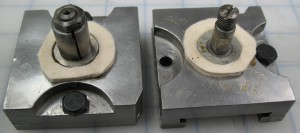
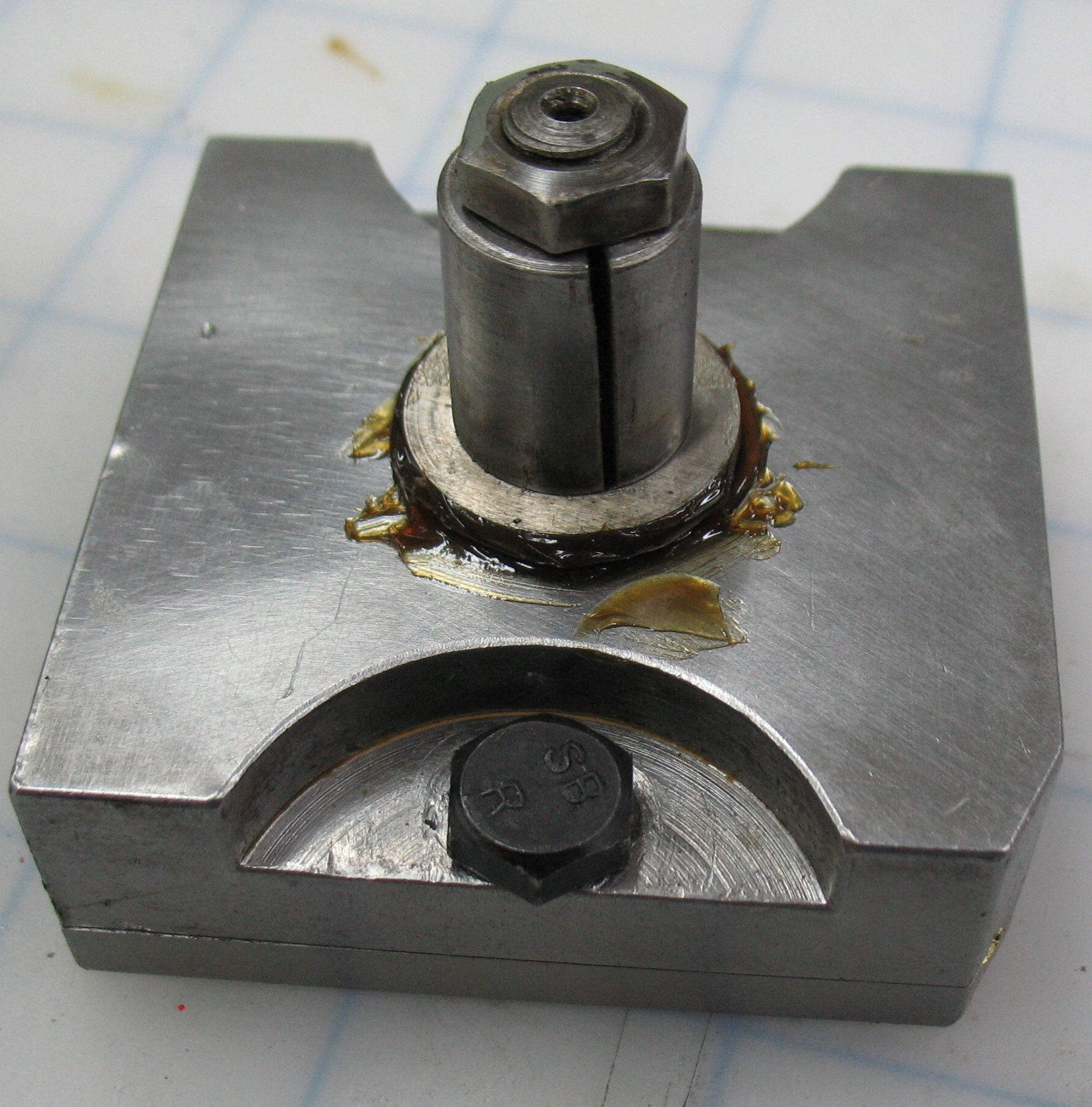
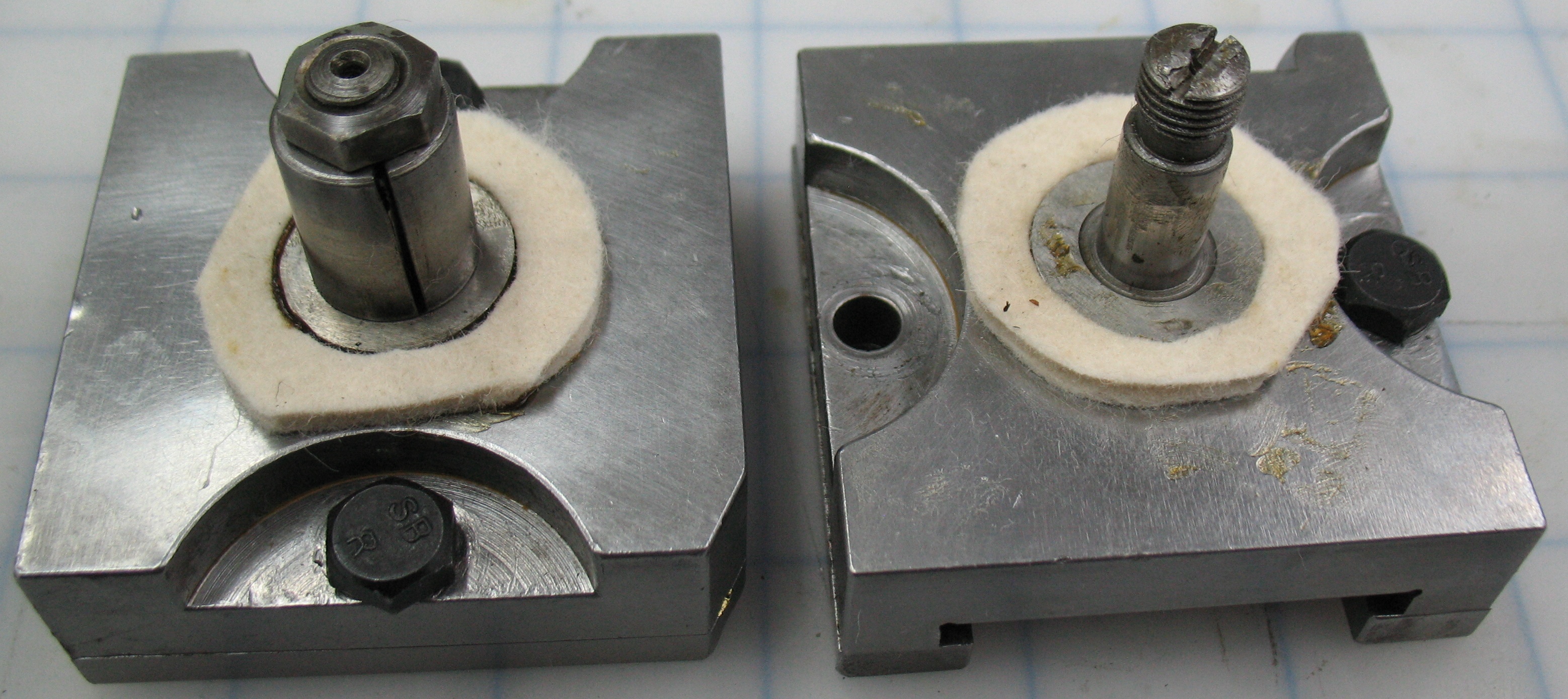
English standard pump on the right, American lead-and-rule pump on the left. Note difference in size (red arrows) as well as adjusting screw and steel wear surfaces (blue arrows).

English pump on the right, American pump on the left. Note difference in size (red arrows) as well as adjusting screw and steel wear surfaces (blue arrows).

Both these pumps take a ⅞″ diameter piston.

The section of the pump that the Pump Body Lever pulls up on to counter the downward push of the Pump (Piston) Lever is wider on the American pumps than on the English pumps, and the presence of the adjusting screw limits the bulkiness of the ends of the Pump Body Lever. This means that you can’t use an American pump on an English caster (or vice versa) without also changing the Pump Body Lever to match the pump. The Pump Lever might also have to be changed but I have not compared the piston stems to see if they are the same size. The stems definitely look different, with the American one being cast while the English one is machined.

I’ll have to look through my parts stock to see if I have a set of American pump levers. I certainly hope the other end of the levers is the same on both casters!

You can also see in the photo where the English pump bodies are fitted with steel wear surfaces where they slide against other parts.

Converting the Composition Caster to Lead-and-Rule casting

One thing I would like to be able to do with my Monotype Composition Caster is to cast spacing and rule.

There is a kit of parts required to make the change-over, and I now have most of the necessary pieces:

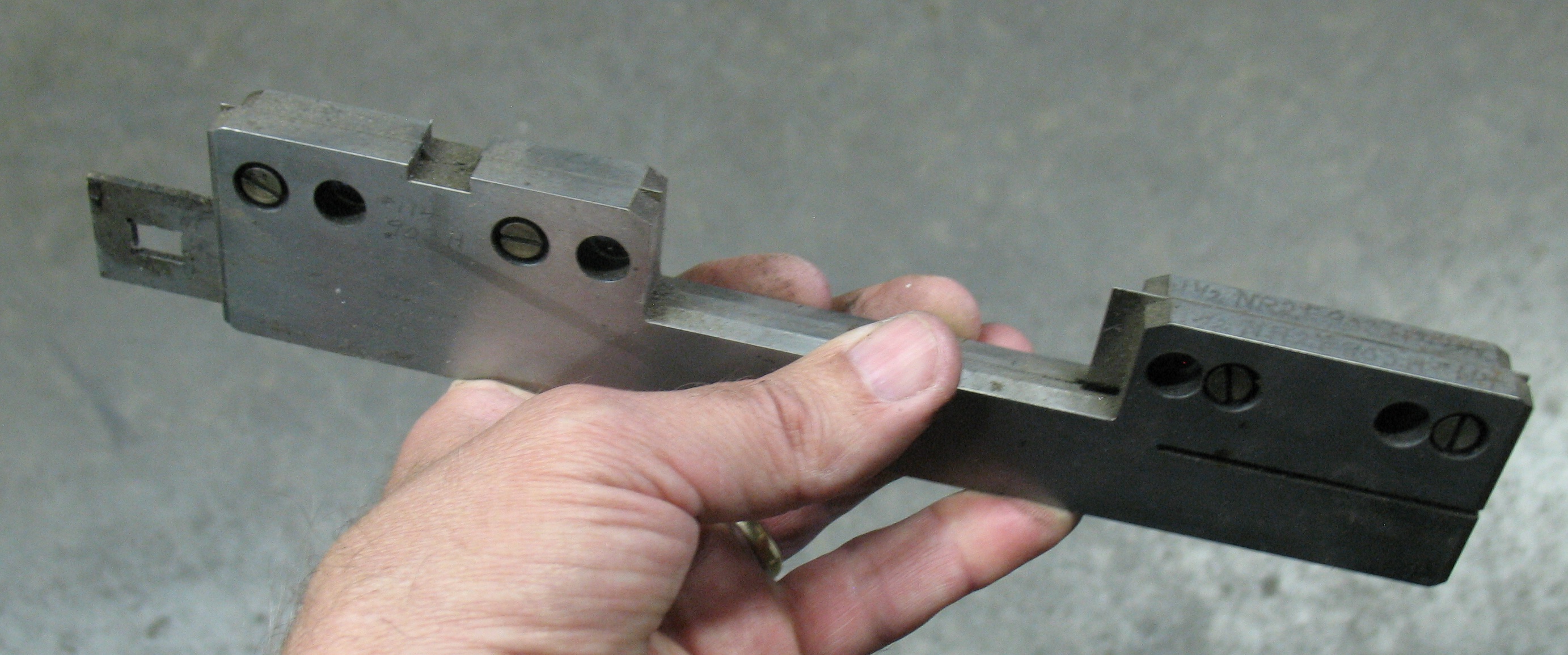
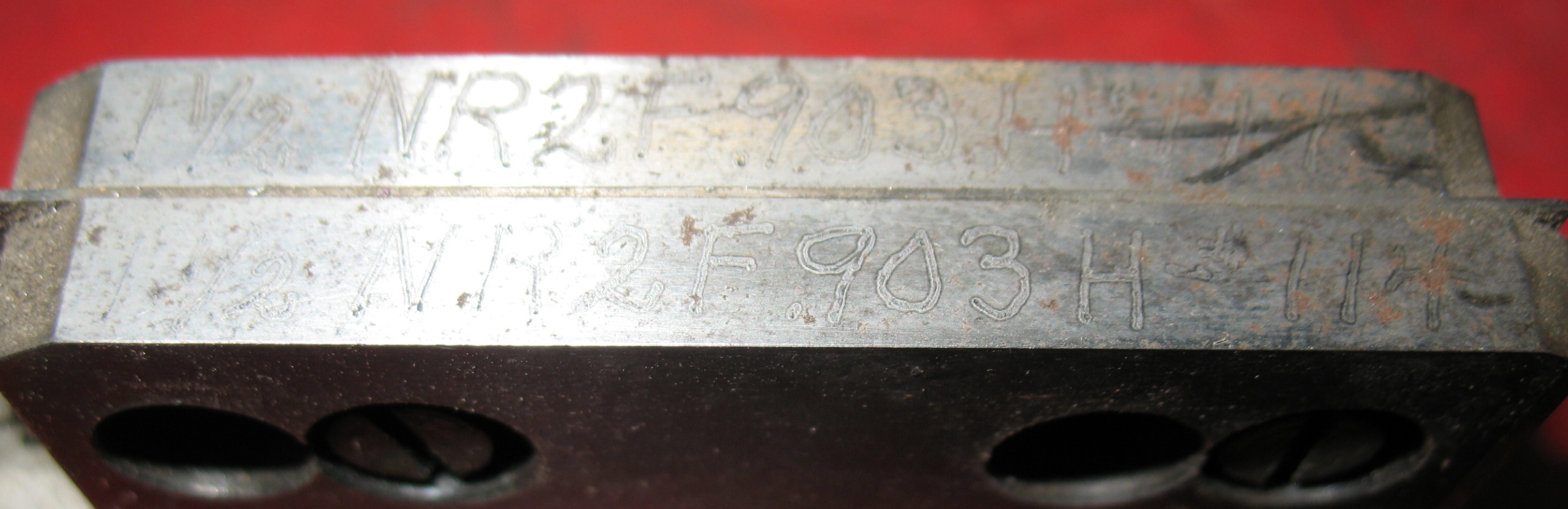
  • A Lead-and-Rule mould (mine is fitted for 3 points thickness)
  • A special pump body with nozzle position altered to match the special mould
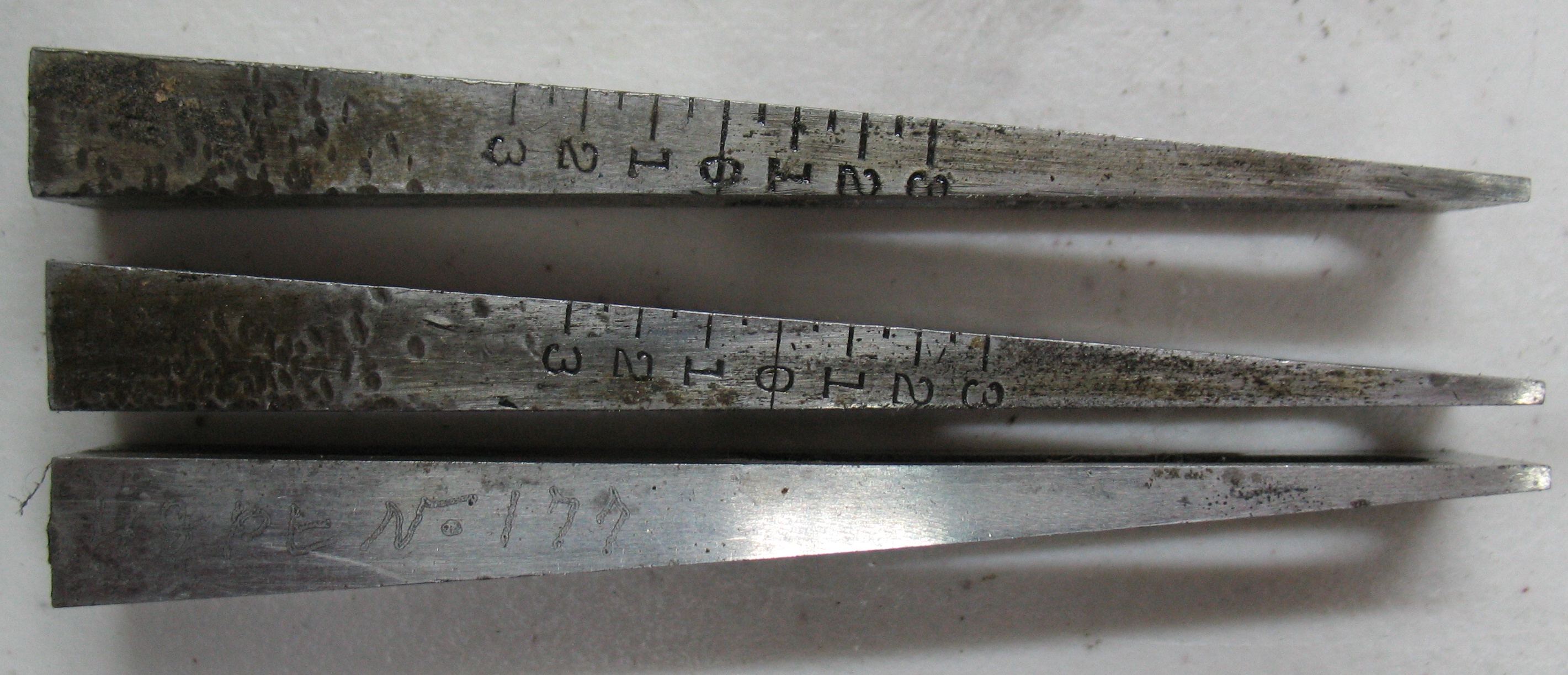
  • A micrometer wedge and stand assembly which determines the exact stroke length of the mould blade
  • A piece that attaches onto the centering pin arm to operate the clamp on the mould
  • An automatic cutter mechanism, although mine is currently a lump of rust

Pieces that are still missing but that I can either cobble together or forego as useful but nonessential:

  • Rule guide tube which keeps the rule from buckling or sagging between the mould and the cutter
  • Mould blade drive linkage which reduces the type carrier lever stroke to just over ¾″ and adds a double-acting spring box

For now I just want to see the machine casting spacing so I don’t need the cutter operational, and so I don’t need the guide tube either. I think I have determined how to cobble together my own linkage as well.

While I had the caster down for a metal switchover, and the mould out as well, I decided to try fitting the pieces I have. One thing I found strange was the large number of parts which the installation steps required one to remove from the caster (from the booklet Directions for Changing from Type Casting to Lead & Rule Casting):

  • Bridge
  • Both Type Channel Blocks
  • Type Carrier with its connecting rod and shoes
  • Type Pusher and Guide
  • Bridge-Lever Connecting Link (the one I forgot to hook up earlier this week)
  • Piston and Pump Body
  • Galley-pan Support
  • Pin-jaw-tongs Spring and its links
  • Locking-bar Cam Lever (disconnect only, do not remove)

Removal of most of these is indeed required to make room for the rule casting parts. I didn’t have to remove the Galley-pan Support, but if I had tried to fit the automatic cutter I likely would have. The Pin-jaw-tongs Spring and links are in the way of the linkage used by Monotype, but the home-made linkage I have in mind does not need this removed. Disconnecting the Locking-bar Cam Lever is probably to prevent the racks from wandering loosely when unlocked (which they can do when the Pin-jaw-tongs Spring is disconnected). The problem with letting them wander is that on each cycle, when the locking bars engage again, the racks will snap to one of the 15 or 17 positions making a loud snap noise and causing undue wear to the locking bar and locking teeth on the rack.

I have an English caster, so removing the Type Pusher requires removing the Rear Buffer (absent on American casters), in turn requiring removal of both sets of rear tongs.

Another side effect of the English caster is that the clamp-on extension for the centering pin arm does not fit very well. The English centering pin arm has some extra lumps of metal to accommodate the English-style low-quad mechanism and these make for a very tight fit for the extension. I find it interesting that the diagram on page 284 of The ‘Monotype Casting Machine Manual shows this extension mounted on an American-style centering pin arm even though this is a manual for the English casters.

The 3 point Lead and Rule mould mounted on my caster

The 3 point Lead and Rule mould mounted on my caster

The Type Pusher (arrow) crashing into the Lead and Rule mould if not removed

The Type Pusher (arrow) crashing into the Lead and Rule mould if not removed

The special lead-and-rule pump in place in the (empty) pot. Note the distinctive long space between the nozzle location and the support pin at the left end.

The special lead-and-rule pump in place in the (empty) pot. Note the distinctive long space between the nozzle location and the support pin at the left end.

I did some other cleanup work on the caster and on some of the removed parts—the Type Pusher Guide was a solid mass of greasy dirt. This included cleaning out the pot, and once that was done I put the special Lead-and-Rule pump body onto its supports and tried to swing the pot closed. It wouldn’t close because, as it turns out, you can’t use an American pump on an English caster because the pump body lever sizes are different.

The the results of this experiment are that I have a few cleaned parts, some notes and measurements to make my own blade drive rod, and that in order to use this I’ll have to find a set of American pump body levers. I may have some in my parts collection.


Top