Fixing a Vandercook SP-15 washup unit

The Vandercook SP-15 proof press at the Book Arts Guild of Richmond Hill is equipped with a washup unit. This is essentially a blade that wipes the ink off one of the rollers in the ink train and a tray to catch the ink that comes off. The original blade on this washup unit was badly chipped and as a result did not work effectively, so a couple of years ago I replaced it. The old blade was a fairly stiff plastic (I suspect it was nylon) and I could not find 1/16″-thick nylon anywhere so I had to use PTFE (“Teflon”) instead. I cut a bevel on the edge of the strip and put in place of the original one. It worked a lot better but still not as well as it should so this week I took another look at the situation:

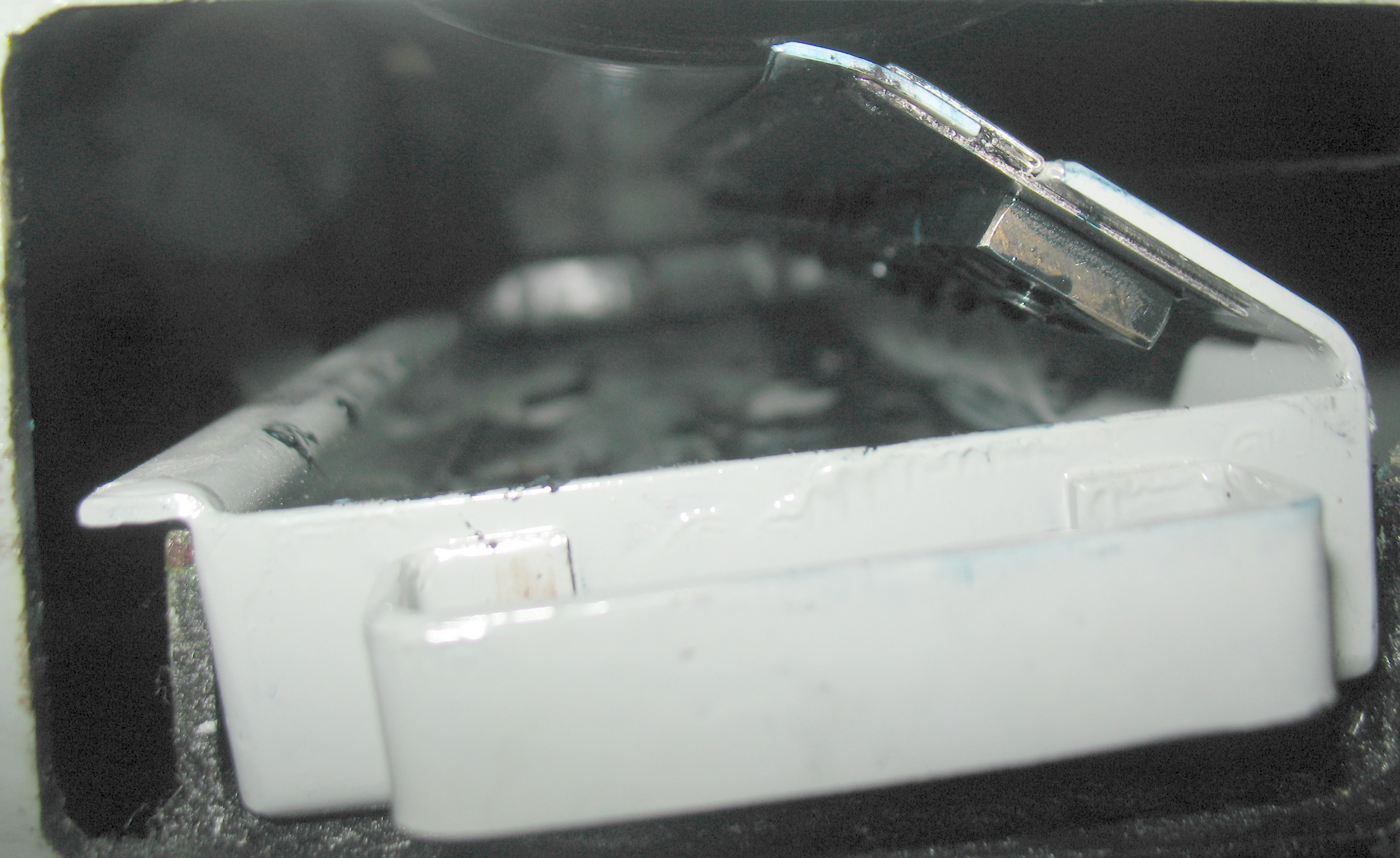
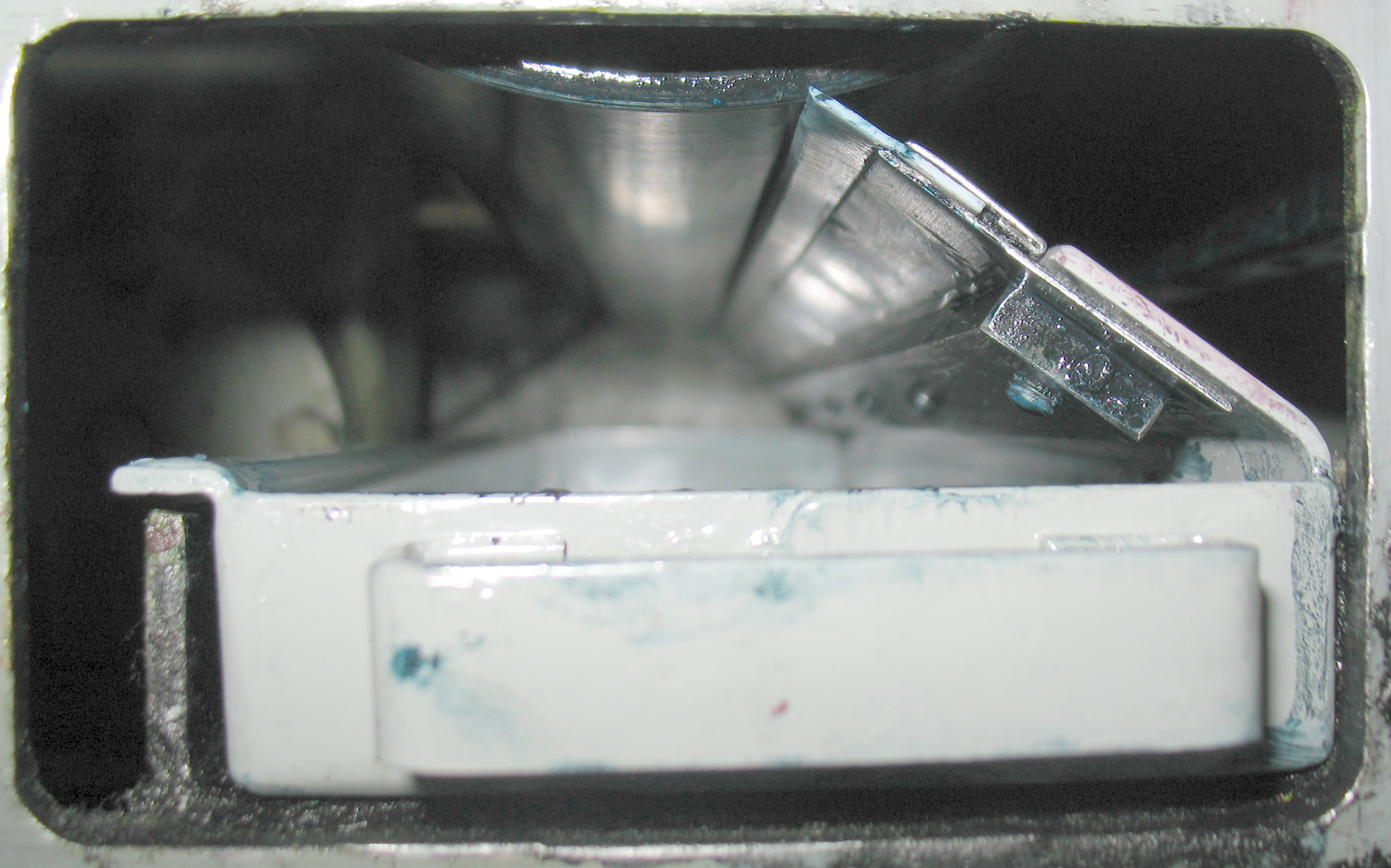
Washup Tray (idle)Washup Unit (engaged)

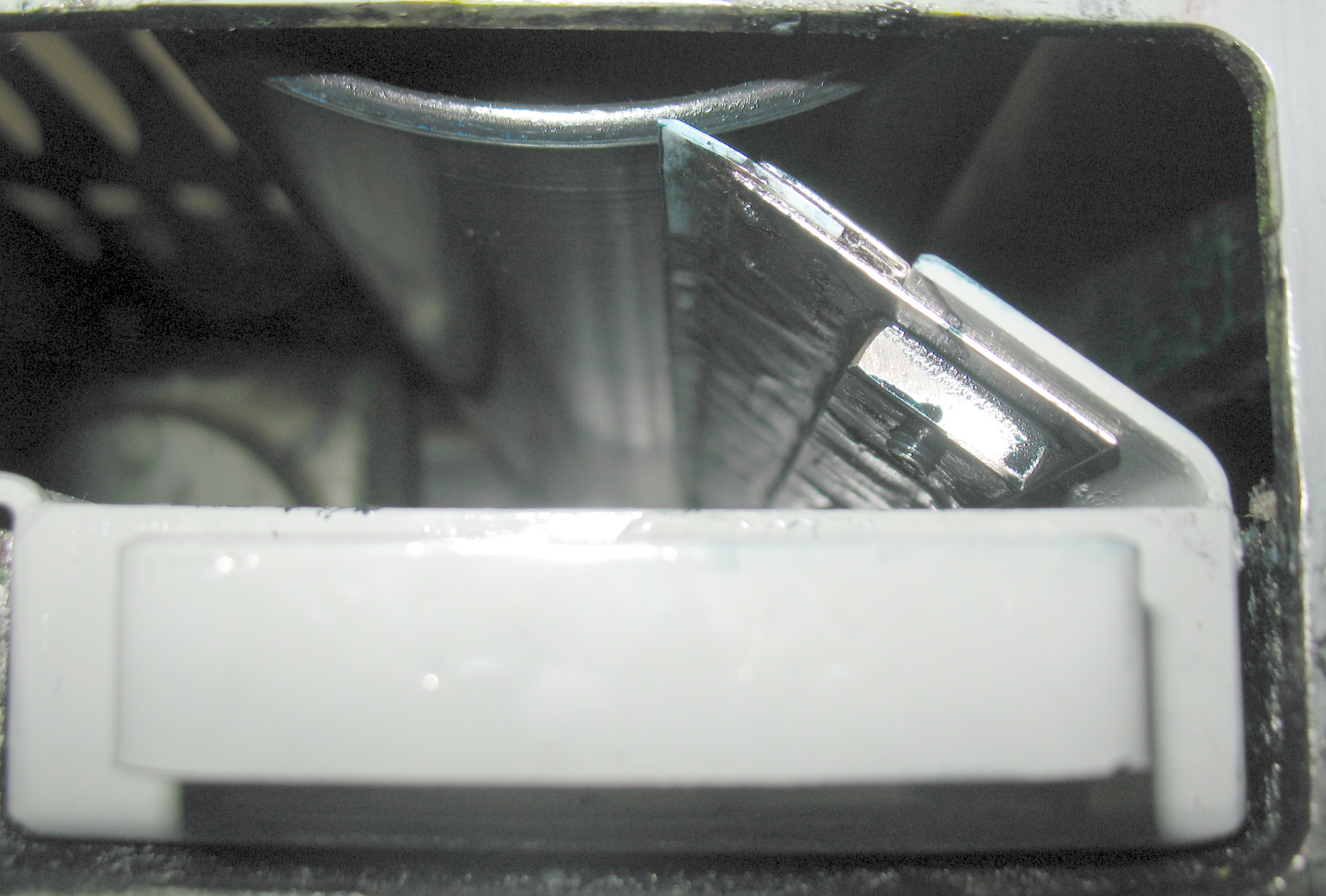
The first photo shows the washup unit in its idle position below the powered ink drum. The blade (white) is not quite touching the drum. Engaging the washup unit (second photo) raises the right side of the tray causing the blade to press against the drum and wipe off its ink film. Ink on the rest of the ink train gradually transfers to this drum so eventually all the ink should be wiped off. If you look closely, however you can see that the PTFE blade is flexing so much that its edge is not contacting the drum; instead the heel of the bevel is on the drum. This makes the wiping much less effective and causes some of the wiped ink to run off the upper side of the blade and thus not get caught in the tray.

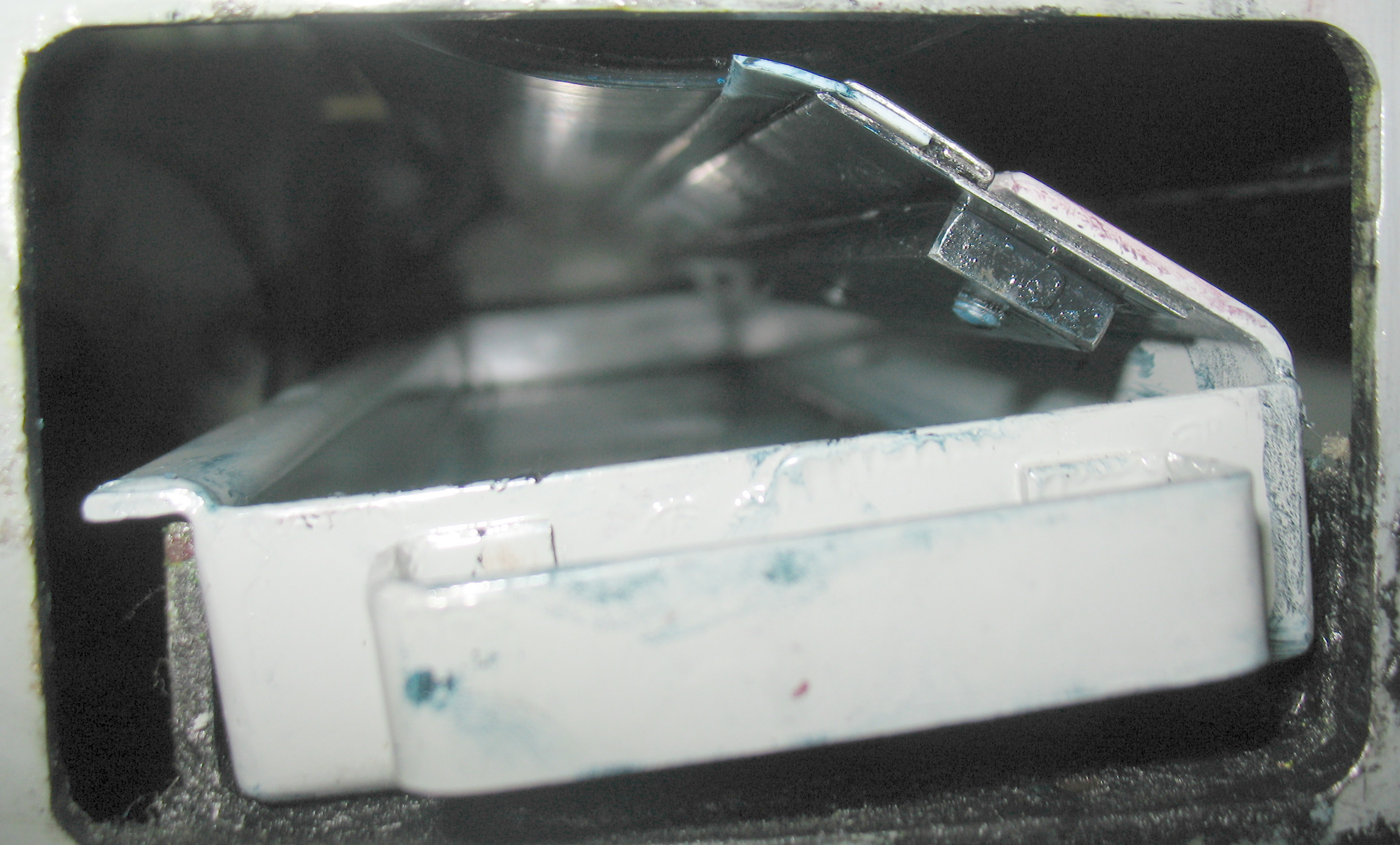
I took out the washup unit and cleaned most of the dried ink off it, and tried the simplest solution: I reversed the PTFE blade so the bevel would face down. This would mean the blade would have to flex quite a bit more before its edge was lifted off the drum surface. Here are the same photos after reversing the blade:

Washup Unit with blade reversed (idle)Washup Unit with blade reversed (engaged)

The blade is still flexing when engaged, but now at least its edge is still the part doing the wiping. This has improved its effectiveness but it is still not ideal. I would like to increase its pressure against the drum by raising the tray more but this would only flex the blade more.

My next try will be to make the PTFE blade narrower and adjust its metal holder up to compensate. This will reduce the width of the unsupported PTFE and thus reduce the flexing. If this still fails to give good results I may try a brass blade instead.

Tagged with:

Making Washi in 2010

Back in June 2010, we all headed out to Prince Edward Island for the first East Coast Gathering of members of the Yahoo Papermaking group. Our gracious hostess was Linda McCausland who runs Heron Cove rental vacation house, where the Gathering was held.

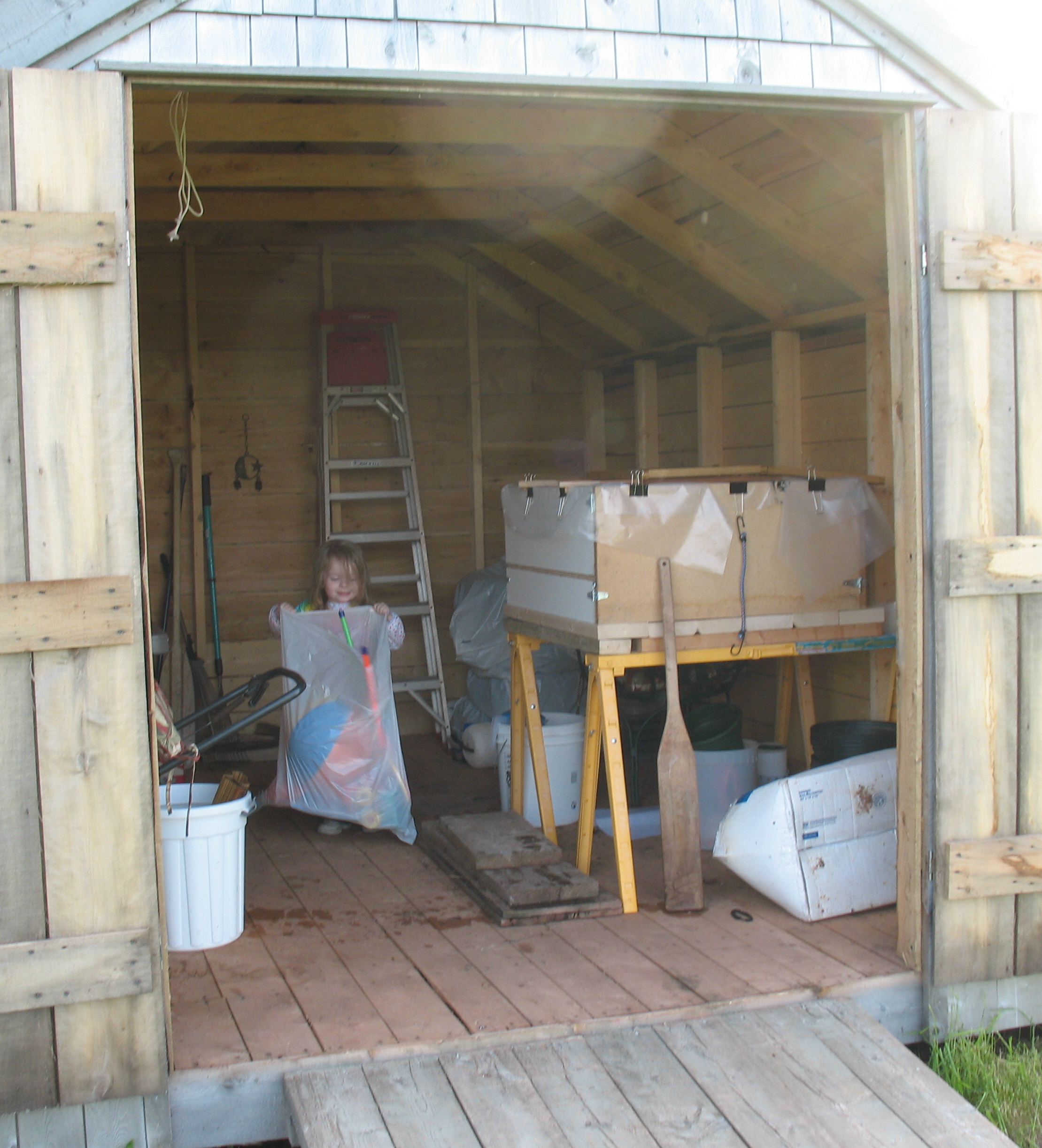
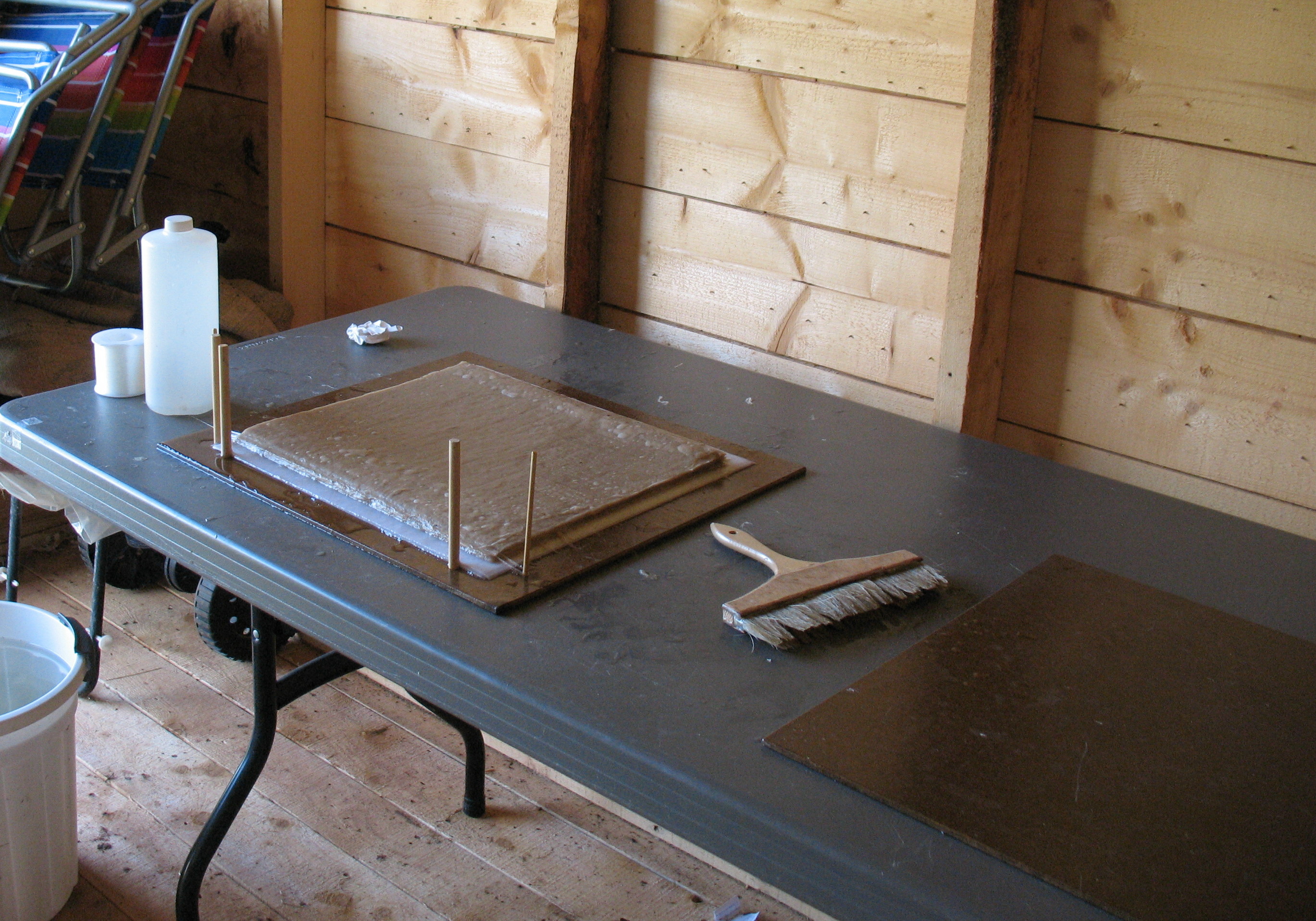
One thing I did was make a batch of washi using traditional techniques. Because the weather was a bit unreliable, I set things up in a garden shed.

Garden Shed

This is the interior of the shed, with Lily having just discovered a bag of beach toys.

Vat and sugeta

This is the knock-down vat I had brought along. The four sides are held together by loose-pin hinges and sit on a base of 2×6 planks on sawhorses. A liner of 6 mil polyethylene with neatly-folded corners is held on by bulldog clips. The clips also act as stops for the two support sticks both for pushing them apart to form a sheet and also for pushing them together to support the sugeta. The sugeta itself consists of a home-made keta (frame) and a su (screen) from Magnolia Editions.

Post

This is the post of formed sheets. There are no felts separating them, but fishing line is run between the sheets along the near edge to help separate them after pressing.

After poor results using the plain bamboo su on the previous day, this time there was a layer of fine screening attached to the su, and as a result I got reliable couching of the sheets. We had made a run into town to a sporting goods store to buy a fine mesh bug jacket, which was then cut up and pieces distributed to attendees as needed. I used a large piece from the back of the jacket cut to match the size of the su, and attached it with the sort of bright red tape that is used in construction to seal vapour barrier and insulation board seams. It was only attached to the near edge of the su, and surface tension kept the rest of it in place.

Audrey took the following short video of me making a couple of sheets, with Lily (3 years old at the time) adding some background sound effects and music.

Although the paper couched fine, after pressing I was unable to separate individual sheets so instead I peeled off double sheets. Although I didn’t get the nice fine paper I was hoping for I still consider this a success since it was only my second or third try at making washi.

Tagged with:

Lassco Spinnit LBM-2.1 Paper Drill For Sale

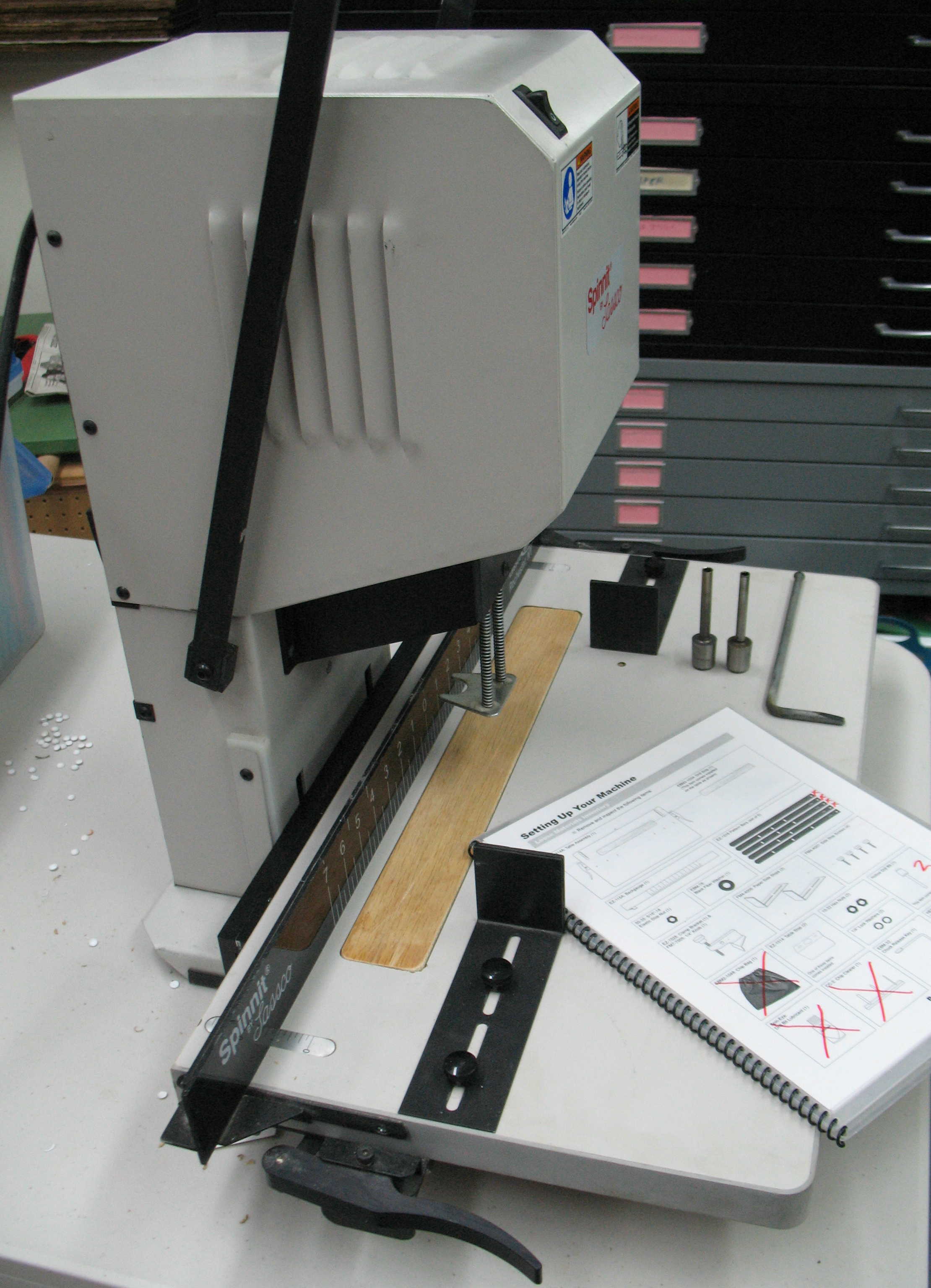
We have a Lassco Spinnit LBM-2.1 paper drill for sale. This is a tabletop machine which operates similarly to the Challenge paper drills and in fact uses the same drill bits.

The bit is a sharpened hollow tube which is spun by a motor as it is driven through the stack of paper. The cutouts push up through the hollow drill and come out a chute at the back where they can be collected for disposal. The drill plugs into a regular 3-prong wall outlet.

This machine is in excellent condition and comes with two bits (9/32” and 5/16”), the original instructions spiral-bound with all pages laminated, a new cutting stick, and a non-original bit removal tool. The table slides from side to side to drill multiple holes and there is a template to put holes at specific positions. The template included with the drill produces 3 holes 4.5” apart, the pattern for standard 3-ring binders. Parts that would have come with the drill when new but which are now missing include 3 other hole spacing templates, a bag to catch the chaff, a bit cleaning tool, a bit lubricant stick, and a couple of Allen wrenches.

The bits could probably stand some sharpening; combined bit cleaning tool/sharpeners are sometimes available from Don Black Linecasting for about $75.

These drills are still available new for about US$1300. We are offering this one for $500 plus delivery and taxes.

Paper Drill Front

Paper Drill Side

Nameplate

The Book Arts Guild of Richmond Hill

This group of about 20 people runs a cooperative shared letterpress shop in Richmond Hill, just North of Toronto. Members have access to use the shop during daytime hours and there are a couple of keys available for after-hours access. We also hold meetings more or less every second Thursday evening from 7:30pm until around 9 or 10. Anyone is welcome to come to the meetings but because they aren’t perfectly regular it would be a good idea to e-mail one of the members a day ahead to ascertain if there is indeed a meeting. There is no formal structure to the meetings; they are more of an agreed-upon time slot when you can show up and expect to find other members there to talk to.

The shop occupies about 400 square feet in the basement of the Vanderburgh House, the balance of which houses the Richmond Hill Chamber of Commerce. It is the CoC’s office hours which control when you can visit the shop without a key, and the CoC’s desire to keep a lid on the number of keys floating around which limits the Guild to holding only two keys for after-hours access.

The Vanderburgh House is a building of some historic importance in Richmond Hill which was actually moved from its original location to its current address of 376 Church Street, at the corner of Weldrick Avenue, just a short block off Yonge Street.

Equipment at the shop includes a Vandercook SP-15 proof press, a C&P Old Style 10×15 (I hope I have that right), and a tabletop Adana press. There are also a guillotine, a type saw, a 100-slot 12×18 galley cabinet, 6 cabinets of type along with all the odds & sods required for letterpress work: spacing, leading, chases, quoins, furniture, a small assortment of ink, etc.

There appears to be a meeting coming up this Thursday, May 16th, in case you want to drop in. If you want to find out about when other meetings are taking place, you should e-mail one of the members (the Guild does not have any Web presence of its own), including ourselves at info@papertrail.ca, Cam Knight, or Thomas Dannenberg.


Victoria Day celebrations in New Dundee

Victoria Day (which this year is celebrated on Monday May 20th) is a big thing in New Dundee. There is a community garage sale, a pancake breakfast at the fire hall, a parade, activities all day at the Park and Community Centre, and after dusk, a fireworks display. There is a bit more information at the New Dundee Board of Trade’s web site. If you’re in the area, come out for the garage sales and stay for the fireworks! If you’re interested in seeing our shop when you stop by just say so and, time permitting, one of us can give you a little tour.

We spent most of today sorting through Lily’s toys and games to separate keepers from sellers for our garage sale. It looks like we’ll have plenty of toys to sell. Between now and then we might even have some time to find some household surplus to sell as well.

Needless to say, between sorting toys and trying to give Audrey a break on Mother’s Day, I’ve made pretty much no progress today on any of my ongoing projects.


A little more blog reorganization

The Categories list that appeared to the right of the posts was quite long so I have removed it from the sidebar and instead placed it on its own page, with a menu item to get to it. I may eventually move most of the contents of this sidebar off to separate pages to make more room for the posts themselves.

I have also added links to subscribe to the blog as a syndication feed (RSS etc); these links are on another separate page reached through the “Feeds” item on the main menu.

A bit of static content on the site

I have added two new menu items to this site. One gets you to a page of contact information if you want to get in touch with us or visit us. The other goes to a page of links to various organizations and friends of ours. The list is sure to get longer as I remember more people to mention, so if you aren’t there and feel you should be, don’t be offended, just contact us and we’ll do something about it!

Some work on the high-volume Monotype pump

I now have a hunk of steel mounted on my lathe that will eventually turn into a home-made long-stroke piston rod (part code hw17H) for increasing the volume capacity of the pump on the Monotype composition caster.

Piston Rod being made

The part is mounted in the lathe, and the drawing is below. The left-hand end which holds the piston is already done, but is hidden by the drive dog. I have just faced it to the correct overall length and have started turning down what will be the top end where the handle attaches.

There is still plenty of metal to remove so it is a little hard to visualize things right now.

Note that the left end has a 120° countersink to match the cone-shaped locknut when all is assembled. To turn this part between centers on the lathe, I turned a matching cone shape on the head of a ⅜” bolt, and without removing the bolt from the chuck, I also drilled a center hole on the top of its head. By screwing this bolt snugly into the finished end of the part I have a good center hole to mate with the turning center in the lathe headstock. The bolt is plated and can be seen in the photo as the slightly more silvery piece that is right against the lathe center.

The threaded hole at the other end, which the handle screws into, is not very critical so it will be one of the last things done, probably on the drill press, once all the lathe work is finished.

Challenge 26” power guillotine for sale

[Note: Please read the comments below regarding the struck-out text]

We have recently upgraded from our Challenge model 265 26” guillotine to a 32” one of even older vintage. We use it to cut up pulp sheets to make them easier to ship, and the 26” one was not wide enough to accommodate all the pulp sheets we stocked.

So the 26” one is now up for sale. It has power cut and power clamp, both driven hydraulically by an electric motor. The motor requires a 3-phase 208-volt supply and draws 11 Amps at 3HP load. Since we moved to our new location, which does not have 3-phase power I have been using a VFD (variable frequency drive) also known as an “inverter drive” to run it. Performance using the VFD has been less than ideal for two reasons: One is that this is an old second-hand VFD which has a current-sensing circuit that gives excessively high readings until the VFD (not the motor) has been powered up for several hours. The other is that the motor size of 3HP is somewhat marginal: when the cutter is at idle, the motor draws about 9 Amps, but during a cut it can draw up to 24Amps. Because the cuts are so short in duration, the average motor load remains under 3HP. For normal motor supply wiring and circuit protection this is not a problem because this high load only lasts a fraction of a second and only occurs perhaps once or twice a minute. Unfortunately the VFD is more sensitive and this leads to occasional overload trips. These are easy to reset as you just have to switch the motor switch off and on again, but they are still a bit of a nuisance.

As a result I am offering to sell this wired as is with the VFD running on 240V single-phase 30Amp, or re-wired to convert it back to 3-phase leaving the buyer the option of replacing the motor with a single-phase one (cost: about $400), or using a static or rotary phase converter. The manual for the machine lists a single-phase 5HP motor as an alternative to the 3-phase 3HP motor,

In any case here are some photos of the machine:

Both the clamp and the knife have dual controls which require both hands to operate, and releasing the knife controls immediately causes the knife to rise back to its idle position.

The machine is sitting on a dolly that I made which allows it to be moved on a smooth hard level floor. A spare knife is included along with the original manual.

Guillotine

Comes with the original manual, spare knife, and manual for the VFD.

Guillotine

The large grey box is the VFD

Guillotine

Rear view below the table showing motor and hydraulic controls.

Nameplate

Guillotine nameplate

Motor nameplate

Motor nameplate

Just yesterday at auction in Goshen Indiana another Challenge 265 sold for US$1350 plus 8% buyer’s premium—that’s $1458 even before taxes. This was a newer model with a deeper and wider table on the operator side and grey paint instead of yellow, and apparently more modern controls.

We are asking $975 for the machine as it is (with the VFD to run on 240V single-phase), or $825 with the VFD removed and the machine converted back to run on 208V 3-phase power. For now I am leaving the VFD on the machine in case anyone wants to see it demonstrated in person.

We have facilities to load this into a truck or trailer and can also mount it on a pallet. If you want it shipped we would hire a professional company to crate it at your expense.

Another keepsake from recent fairs

I seem to have come down with a cold. Not a very bad one, but still sniffles and a (stronger than usual) desire to just sit around and do nothing.

Still I am managing to poke away at various projects but not with enough progress to report on any of them.

Top