Our New Type-and-rule Caster in Motion

I’ve cobbled a motor mount and installed a new drive belt, and our new type-and-rule caster now runs:

It still needs work, though. For one thing, the belt either needs tension adjustment or some belt dressing so it doesn’t slip when in the higher geared speeds.

Even more important, this machine still needs its pot, pump, and cutter/stacker refitted before it can actually produce anything! This work includes changing the pot to top-crank and making a new temperature controller since the original one has been converted into a museum display.

A PCB for the Monotype Computer Interface

I’ve been slowly plugging away (apparently, for at least 9 years!) at an interface to control my Monotype Composition Caster using a computer. The caster was originally designed to be controlled by a 31-channel punched paper ribbon, which is read by compressed air. The holes in the ribbon allow the compressed air to enter specific circuits in the caster, which select which matrix to cast, when to start a new line, and other control functions.

Blank ribbon is now very hard to come by, and perforating it with an appropriate program requires a whole separate set of equipment: At least one Monotype Keyboard, a collection of keybars and stopbars corresponding to the various fonts one wishes to use, and other accessories. These are all large, heavy, and rust-prone unless stored in a climate-controlled location, so many Monotype owners prefer to avoid physical keyboards altogether.

In addition to avoiding all that extra hardware, the computer system is capable of making the caster do things that, though possible using a physical keyboard, would require prohibitively complex calculations on the part of the keyboard operator.

There have been several computer interfaces designed through the years, gradually becoming easier to use and to install as designs improved. I’m fussy and find even the latest units somewhat clumsy, having a separate box and a bundle of tubing going to the caster’s reader head, so I’m adding to the fray with my own design.

My design uses compact pneumatic valves which allow the entire unit to hang directly on the reader head, requiring no tools to install. It detects the caster cycle using the motion of the same part of the caster that applies the compressed air when reading a physical ribbon.

So far, though, my unit is still a prototype, and the electronics are built on a prototyping board, with several bundles of wire connecting it to the unit on the reader head.

The interface sitting in a crate on my way to the 2023 ATF conference in Maine

I’m finally addressing this. I’ve actually had some PCBs made, and have all the parts (in theory) required to assemble this so all the electronics (except the power supply) are part of the read head unit.

Five PCB’s and a metal stencil for applying solder paste

So far, I’ve found one mistake in the board: I used the wrong “footprint” for the resistors: The parts I bought—and thought I was designing for—have what is called a 0603 form, 0.6×0.3mm, but the pads on the board for the resistors were incorrectly made for 0402 form, 0.4×0.2mm. It looks like I’ll still be able to install the 0603 resistors, and though they’ll have less-than-perfect solder connections I’ll still be able to test the board for other mistakes. I could buy new resistors in the 0402 size, as they are not that expensive, but I already feel that I’m working with dust motes handling the 0603 ones!

I’m not entirely sure why I went with such small parts in the first place as there is plenty of room on the PCB for larger ones. I suspect that I confused metric and inch-sized designations, and thought I was specifying 0603 in inch sizes, equivalent to metric 1608 (1.6×0.8mm), which is 2.54 times larger in each dimension.

Even though I had 5 boards made, they will likely not be the final design, but will be useful for testing mechanical fitment and for practicing soldering such devices (not to mention finding errors in the circuit). Normally for quantities I’m dealing with such boards are soldered using what is called a reflow oven, where one applies a solder/flux mix in paste form to the solder pads, places the components, and heats the entire board until the solder melts. I may have access to such an oven but I don’t know if it is large enough for my boards, so I may end up with some makeshift method using a heated metal plate or two.

Two workshops in August

We’ve scheduled two workshops for Saturdays in August:

Both workshops will take place at our shop in New Dundee, and run from 9am to 4pm with a 1-hour lunch break.

Course fees are $80 + HST for a total of $90.40, including materials.

For more details, please follow the links above, and if you want to book a spot, you can e-mail us or call us at 519-884-7123.

Pin Marks on Type at the Mackenzie Printery

I was recently asked about a marking a friend had seen on some type, wondering if it could be from the Montreal Type Foundry, or even if such a place ever existed.

First, a bit of type-casting technology: Since the technology developed by Gutenberg, type was originally cast using a hand mould, which as its name suggests is a mould that the user holds in their hand while casting. It generally has two main pieces, and also holds a matrix that has the actual glyph to be cast, and the user fills it with molten type metal using a small ladle. After a few seconds the metal has solidified and the users takes the two halves apart and removes the new piece of type. In this way one could cast perhaps 4 pieces of type per minute. The resulting type still required finishing work before it could be used, including breaking off the jet where the metal was poured in and cleaning off any bumps that would prevent the type from standing or locking up properly.

In the late 1830’s, a machine called a pivotal caster was developed which essentially went through the same motions, but mechanized at the turn of a crank. In order to assure proper ejection of the type, one side of the mould was equipped with a small pin which protrudes a bit into the mould cavity. This is sometimes called an “ejector pin” but that is a somewhat misleading name because that makes it sound like the pin actually pops up to eject the type. In fact, these pins were fixed, and only acted as a sort of snag to ensure that when the mould opened the type reliably stayed attached on one specific half of the mould.

The pivotal caster allowed a faster production rate and made more consistent type. This was in part due to the consistent injection of molten metal because this caster also included a pump mechanism for the metal. This machine was the primary means of casting type for perhaps 50 years, but by the late 1880’s, other machines, notably the Barth caster, were developed. These machines ran faster and produced type that required little or no finishing steps. These newer casters had no need for an ejector pin, so the marks left by the pins were no longer found on type. The pivotal casters remained in limited use in smaller foundries or for smaller production runs.

Foundries using pivotal casters realized that they could engrave the head of the pins to leave a distinctive mark on each piece of type as a trade mark to identify where it was cast.

Now that old fonts of type have their own historical interest such pin marks can be an important tool in identifying the history of a font of type.

I recently did a quick survey of pin marks that I could find on type at the Mackenzie Printery and Newspaper Museum where I volunteer, and here are some of the more legible ones I found:

The mysterious “M.T.” pin mark on an en space which probably started this whole adventure

A pin mark from the Baltimore Type Foundry, a.k.a. BaltoType

A European entry from Lettergieterij Amsterdam (the ‘T’ stands for “Tetterode”, the foundry owner’s name)

I found several pin marks from the Chicago Type Foundry. I’m not sure of the significance of the “28”.

As for the Montreal Type Foundry, this did exist between about 1830 and 1887. It was succeeded in Montreal by the Dominion Type Foundry and around that time the Toronto Type Foundry was also established. I have, however, no definitive proof that this “M.T.” pin mark is from the Montreal Type Foundry, and so far I’ve only found two instances of it at the Museum, both on spaces rather than type.

I should note that although casters no longer have ejector pins, it is still possible for the mould to be marked to trademark the type, but this is trickier to do with newer moulds because of tighter tolerances and the way the mould parts must slide past each other. Another practice was for a foundry to mark the counter of the type by modifying the matrix; this was usually only done for a few sorts, notably uppercase H or M.

Swing Frame Removal, Part 2

On our new Type and Rule Caster I want to replace the swing frame assembly with one where the crank to raise and lower the pot is above the pot rather than below it, to avoid needing to have my face up close & personal with a lake of molten type metal.

So far I’ve removed everything except the Swing Frame Post, which is the fixed half of the hinge that the pot rotates on.

The three bolts from the Swing Frame Post along with a linkage pin from the pump operating bell crank

This is attached to the main caster frame by three fasteners: a bolt with a 1″ hex head, also about 1″ long (the head, not the bolt), and two large slot-head screws. One of these has a head diameter of about ⅝″ and the other about ⅞″.

To remove these I needed a large slot screwdriver. Search the web for “large”, “giant”, or any such other adjective you can imagine, “screwdriver”, and the largest real screwdriver you find has a ⅜″ blade, hardly sufficient. One exception is that Hand Tool Rescue has one with a 1″ wide blade, but that is too large because these screws are in counterbored holes. I had a vague memory of actually owning a sufficiently large screwdriver, and eventually found it:

Screwdriver, about 67cm/26″ long, with caster centering pin arm for scale

By holding this screwdriver in the screw head with my body, holding a wrench on the shaft with one hand, and hammering on the wrench with the other, I got the screws loose.

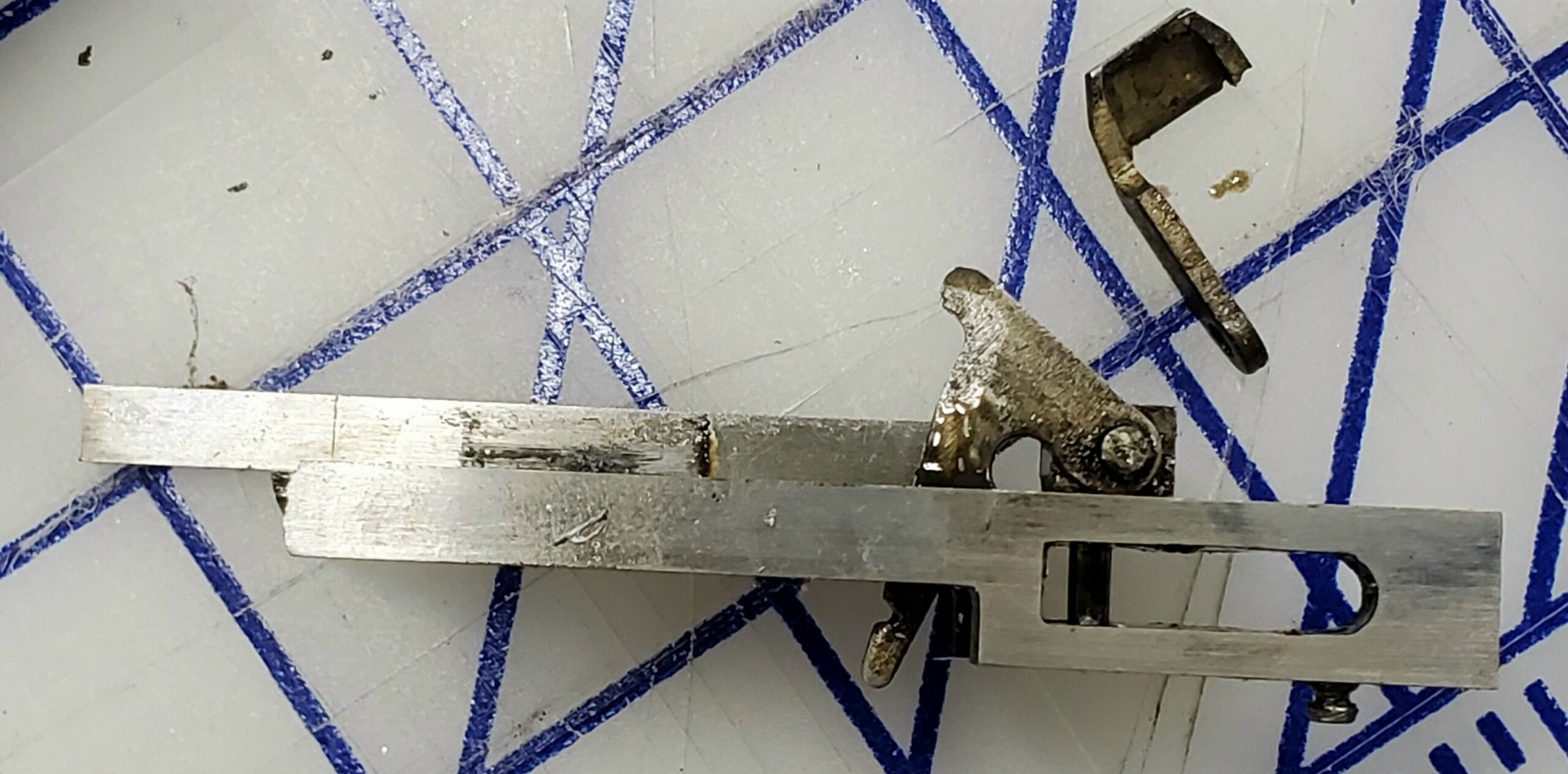
There was also the linkage that operates the pump keeping the Post captive on the machine, so this had to be disconnected. The pin between the pull rod in the caster is not very accessible in its idle position:
It is apparently also hard to focus on. Turning on the pump and cycling the caster to the correct position moves this pin to a much more accessible location:

By removing either of the cotter pins the post can easily be removed, allowing the Swing Frame Post to be entirely removed.The next step is to collect the parts to install the newer Swing Frame Post and Swing Frame. The replacement Post I have is fitted with lubrication pipes to allow this bell crank to be easily lubricated, but the pipes are damaged and must be replaced before I install it.

What’s Inside a Paper Pulley

The motor that came with our recently-acquired Monotype Type and Rule Caster was fitted with 2″ a pulley suitable for a flat drive belt to run the caster. Such pulleys are shaped with a bit of a crown, that is, the pulley is a bit larger in diameter near the center of its length and tapers off a bit towards each end. This crown keeps the drive belt properly centered with no need for additional guides.

This particular pulley was, however, quite worn and the belt would not run on it properly, so it would need replacement. It was of an old style not seem much any more (not that flat belts themselves are used much in modern machinery either): a “paper pulley”. The main body of the pulley was just a tight stack of paper, more like boxboard (think of the stuff cereal boxes are made of), packed onto a hub and ends made of a single piece of metal. The metal is likely zinc or a zinc alloy, and was cast as one piece around the stacked cardboard.

One end of the pulley actually bears the markings “Browning Paper Pulleys” and “Maysville KY”, so “paper pulley” is indeed the correct name for these. The Browning company still exists in Maysville, but apparently they stopped making paper pulleys around 1977.

I pulled out most of the paper to see what else was inside. Because the pulley was cast onto the paper, it is actually difficult to remove all the paper cleanly, and much of it is left bonded to the metal in the hub:

One of the flanges has two holes in it, about ¼″ diameter, 45 degrees either side of the setscrew, and these holes continued into the stack of paper. The holes appear to have been drilled after the hub was cast around the paper. In the bottom of the holes there were two filler slugs that appeared to be the same metal as the hub, positioned about halfway lengthwise, and the rest of the holes were filled with cork. I’m not sure what purpose these serve, maybe this is how the pulley was balanced.

I’m not entirely sure how this would have been made. The layers of the paper core would probably be die-cut with a hole in the center to form the hub and a boss for the setscrew, but I don’t understand how they could be held tightly stacked while the hub was cast. There is no evidence of any sort of glue holding them together. It is possible, even likely, that the paper layers started off larger than the final diameter of the pulley, so the stack could have been held and lightly compressed by its edges. This would not, however, allow for much compression because the hub area of the stack would still bulge. Another possibility is that the paper was pressed hard in advance, and before it had a chance to rebound completely, the casting was done, followed by exposure to perhaps steam to soften the paper and allow it to puff up again to get everything tight.

Such pulleys now seem to be pretty much unobtanium, so I’m thinking of making myself a replacement. I’d make the hub and one flange as a single piece, the other flange as another piece, and use four bolts to pull the flanges together and compress the paper. The bolts will also transfer the torque from the flanges to the paper, and ideally the loose flange will be somehow keyed to the hub. Perhaps I can just weld it once the stack is tight.

Actually, McMaster-Carr appears to have a suitable replacement pulley for about $100, so I may just order that rather than taking on yet another side quest.

Howard Iron Works Print Expo & Fair 2025

We’ve just received advance notice that this year’s Howard Iron Works Print Expo & Fair will be on Saturday, September 27th, from 10am-4pm, and will feature as special guest Amos Kennedy, Jr.

We’ll be there with our selection of stuff for sale, and there will be museum tours, demonstrations, and workshops available to those attending.

As the fair nears we expect there will be more details on the events of the day posted at HIW’s web site.

Initial Work on the New Type & Rule Caster

While the weather was good for working outside I started to work on getting the new Type & Rule caster operational again, for now concentrating on the pot and pump side of things.

The caster is fitted with a bottom-crank mechanism for raising and lowering the pot, and in this particular case the crank was missing. However, a wrench could be used on the nut that was supposed to retain the crank to turn the shaft and lower the pot. Although I had oiled the raising/lowering screw threads this was still quite hard to turn. After a few minutes of hard work I had the pot lowered, swung out, and the pump removed along with a collar of hardened type metal.

The pot lowered and swung open

The pump, with attached lump of metal. Note this is the special pump for strip casting, which has the nozzle in a different position.

The ultimate goal here is to refit this caster with a top-crank mechanism, which I have as a spare from a scrapped English caster. The bottom-crank is unpleasant to use because to operate it one must bend down with one’s head/face right next to the pot, and it is not unknown for the pot to shift and slosh molten type metal when being raised or lowered. Furthermore the crank and screw have a plain (sliding) surface bearing the weight of the pot, which adds to the friction of turning the crank. The top-crank mechanism can be operating while standing erect, and includes a ball thrust bearing to reduce the effort required to turn the crank.

I plan on replacing parts back to the Swing-Frame Post (38H) because the replacement is fitted with tubes to lubricate inaccessible parts from a small oil tray on the top of the post.

To break things down into lighter individual parts I stripped down the Swing Frame, removing the pot and the entire pump lifter mechanism, leaving just the bare swing frame, which on this caster seems to combine the actual Swing Frame 37H and the Table 37H12 (under the pot) as a single casting. I also removed most of the pump operating mechanism, leaving only the Piston Operating Rod (19H) and its attachments.

It was essentially impossible for me to raise the Swing Frame again as turning the crank nut in the other direction merely removes the nut. So I proceeded to remove the Swing-Frame Screw 39H.

Or at least to try. It should have been possible to hoist the Swing Frame and have it and its raising Screw just slide up, and then turn the screw further to remove it completely out of the top of the Swing Frame and Swing-Frame Post. There was, unfortunately, some combination of rust and gummy dried oil that prevented this. I used our fork lift to lift up either under the Swing-Frame Table or under the bottom of the Screw with enough force to start to tip the caster over but nothing budged.

After swinging the Swing Frame while applying lifting force I got the Screw to rise up 2 or 3mm, at which point it jammed. This also raised the pot enough that it had to be in its closed position to rise any further. I lowered the fork lift and hammered the top of the Screw, and after a few blows it dropped suddenly back to its normal position.

A few up-and-down cycles like this allowed the Screw and Swing Frame to rise to the former’s upper (casting) position. At this point I should have been able to just turn the screw more and pull it out the top, but the screw refused to turn any further. The Swing-Frame Screw Washer 39H2 seemed to be firmly stuck on the screw, preventing it from threading any further upwards.

I applied a torch to this washer in an effort to try to free it, and eventually managed to remove the Screw completely using a combination of a wrench on the crank nut and a pipe wrench on the top of the screw which was now projecting above the top of the Swing-Frame Post. The washer fought me the whole way off, but I eventually removed the Screw and Swing Frame.

The Screw was scarred at the top by the pipe wrench (and hammering it down), and at the bottom by the Washer. I don’t plan on re-using this Screw but if it were needed the damage could be cleaned up on a lathe or, with a little more trouble, using a file.

Scarring at the top of the screw from using a pipe wrench

Scarring at the bottom of the screw from removing the washer

The cause of the problem appears to be an imposter 39H2 washer:There is no way this is a real 39H2 as there is absolutely no reason for this part to include a keyway, and it also does not have the finish typical of Monotype parts. This looks more like a commodity driveshaft spacer that was used instead of the real 39H2, and because it was too close a fit on the screw the edges of the keyway dug into the shaft.

Anyway, now that all this is removed the next item is the Swing-Frame Post, which is just held on by a few large screws, and so far I’ve had little trouble with seized fasteners so this should be easy to remove. That will allow me to test if the newer part fits in its stead.

An Addition to the Type Foundry

Two years ago I found out that this Monotype caster, fitted for strip casting, was available for free in the Toronto area.
Unfortunately, at the time, I had no room for it and needed to expand our shop space to make room. Much more unfortunately, through a misunderstanding, the owner thought I was not interested in it, and started giving it the (very slow) heave-ho.

The pot controller was removed to make a decorative display, and cutter/stacker was removed to reduce the machine’s bulk and subsequently misplaced. The caster then spent a year outdoors before I picked it up just this week.

Here’s how it looks now:

A very sad state. It is fortunate that the machine had been coated with a machinery storage coating (“Cosmoline”) so the rust has not gone very deep.

My collection of spares should be enough to make up a pot controller, and I have a cutter/stacker in rough condition that I can fit to the machine, so I have the makings of a working strip caster. As well, the former owner will look around to see if the cutter/stacker is still around.

This is actually a Monotype Type and Rule Caster sometimes inexplicably called an “Orphan Annie”, fitted with the attachments for continuous strip casting. It is marked with the improbable serial number 5000:

L-R: Left rear table corner, Rear end of rear pin block, Left end of front pin block

The fact that the same serial number appears on several places implies that this truly is the machine’s serial number, improbable though it may seem to have a number that is an exact multiple of 1000. Unfortunately there does not seem to be any easily-found serial number index or census of machines for Monotype equipment.

I have a series of old parts manuals from various years and I may try to match specific parts against these to determine when the machine was made, but for now the main goal is to chase out all the water and protect against further rusting.

An Addition to the Workshop

I just purchased a new-to-me machine for my workshop:This is a DoAll DH-612 manual surface grinder. Based on the serial number this one was made in 1959 and that may have been the first year of production for this model as I have found no references to earlier serial numbers.

The machine needs a good cleaning, and I’m hoping the ways (the surfaces the work table slides on) are in good condition, though if not they can be refurbished.

It is partially fitted with DoAll’s patented (US#2470350) “Cool Grinding” feature which injects coolant into the grinding wheel itself (which is porous) so there is a positive flow out of the working surface, lifting away grinding swarf better that the typical flood coolant system would. By “partially fitted” I mean it has the special coolant control valve and the special grinding wheel flanges required, but otherwise no provision for coolant: No pump, no tank, no hoses, minimal splash shielding, but all these can be made up from generally available items.

This big issue is that the motor runs on 550V 3-phase power, and all I have available is 240V single-phase. A VFD would be able to run a 3-phase 208/220/240V motor but not a 550V one. Some combination of VFD and (auto)transformer(s) might be able to do the job. My first thought was to step the 240V single-phase up to 600V and use a 600V VFD but VFDs in that voltage range require 3-phase input. Another possibility would be to use a 240V VFD and a 3-phase autotransformer to step up to 550V but this would be bulky and the VFD might not like the transformer on its output. There is also the concern that using VFDs (which generate high-frequency electrical harmonics) on older motors can cause issues with the motor lifetime because current is induced in unexpected places like the bearings causing them to wear prematurely, and voltage spikes can also cause premature insulation breakdown.

The grinder has an integrated spindle and direct-drive motor, so I will have to disassemble part of this to allow me to fit a pulley and mounting for a single-phase 220/240V motor to use belt drive. On one other DoAll model (VS-612) the motor can clearly be reversibly disassembled leaving the bare shaft, but on this machine removing the existing motor may be a one-way trip.

Once I have this working I hope to be able to use it to recondition Monotype parts, particularly worn wedges (which determine the width of the cast type) and worn moulds (assuming I can first build up some replacement metal). I might also try to modify some display mould blade insert kits to allow me to cast unusual sizes like Didot-point-sized type. The Didot point (0.0148″) is slightly larger than the almost-American point (0.0138333…″) the Monotype system usually works in, so I currently have to cast Didot-sized type faces on the next size up of type body.

Although this post is tagged “Basement Workshop” this grinder is very much never going anywhere but ground level!

Top