
The Mackenzie Printery and Newspaper Museum maintains a Whitlock Pony press in Wainfleet, Ontario, in a building at the local Fairgrounds. Every Labour Day weekend, the Marshville Heritage Festival is held on the fairgrounds, and as part of that, we at the Museum run the Whitlock as well as other printing equipment.
We have long had a few nagging minor issues with this press.
One is that, on the second (delivery) rotation of the cylinder when the grippers open up, there is nothing holding the sheet to the cylinder except for the suction between the sheet and the tympan surface. This makes delivery unreliable because it is essentially relying on the inertia of the sheet of paper to keep it moving until it reaches the delivery tapes. With large sheets, the weight of the tail end of the sheet will pull the sheet back, where it will land on the returning bed and make a messy paper jam.
On a somewhat similar (but much, much cleaner) Miehle press at the Howard Iron Works museum, there are idler rollers which apply a bit of pressure to hold the paper in place on the cylinder until it is delivered to the tapes.
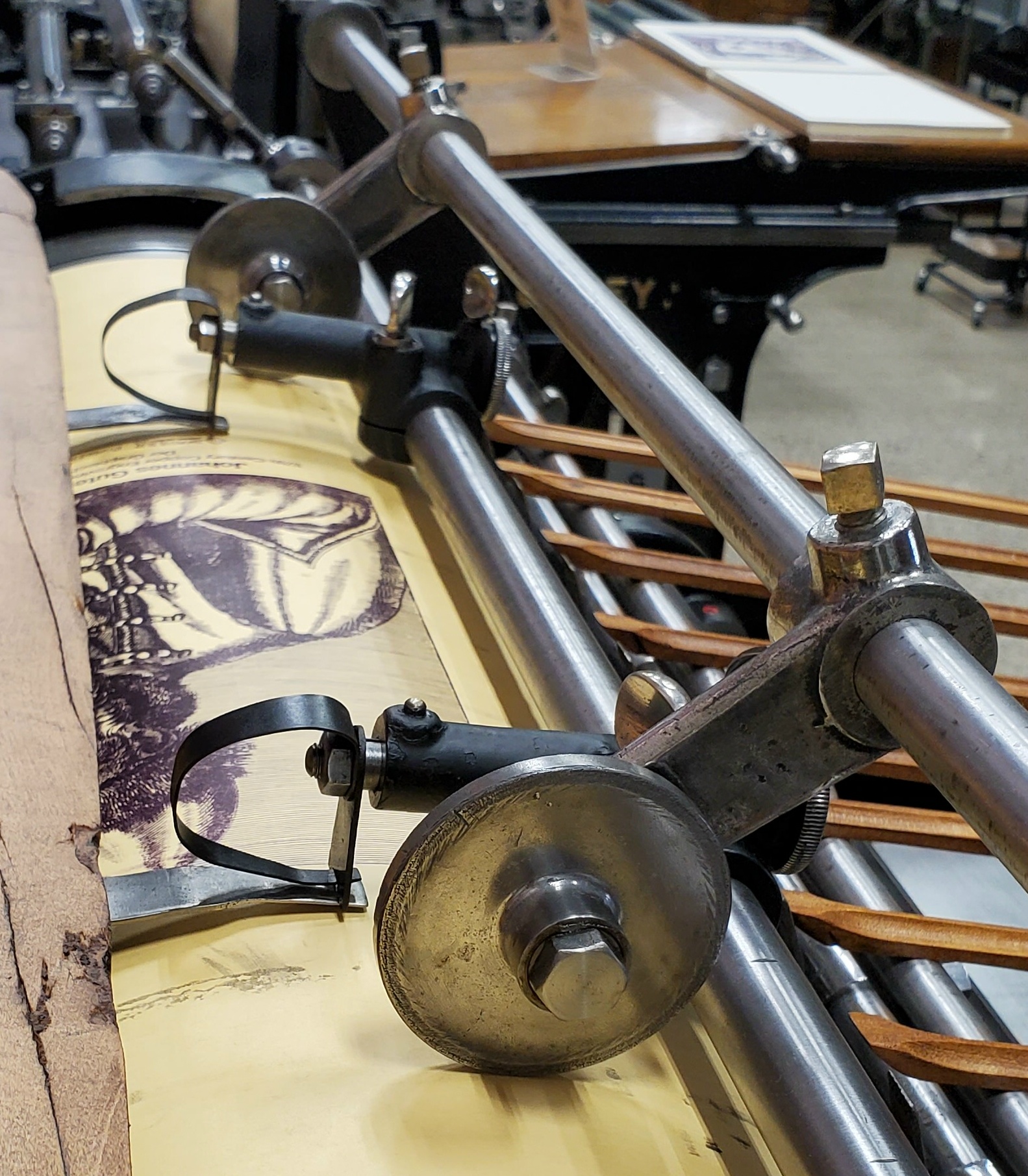
Anti-slip rollers on Miehle press
Similar rollers can be seen on some advertising of Whitlock presses, but these are hand-made illustrations and between the quality of reproduction, the possible artistic license on the illustrator’s part, and differences between marketing concepts and actual products, we can’t rely on these much.
The second problem we have is that, once the grippers release the leading edge of the sheet, it must lift up enough to separate from the cylinder and slip over the paper support fingers to be guided to the delivery tapes. These fingers lower close to the cylinder to try to catch the sheet, but you can only set them so close before they risk snagging and tearing the tympan. The press currently relies essentially on the stiffness of the paper for it to lift and ride over the support fingers.
This is fine for the paper we currently run, but if we try to print on softer paper, or when the paper is damp on a humid day, the edge of the sheet goes over some of the fingers and under others, ultimately becoming speared on them and shredded.
The press actually has another set of fingers that are just under the leading edge of the sheet, and these are clearly intended to lift the edge to clear the support fingers. The lifters have to stay tight to the cylinder until the grippers release the sheet, then they should lift up a bit.
Similar fingers are fitted on the Miehle at Howard Iron Works:
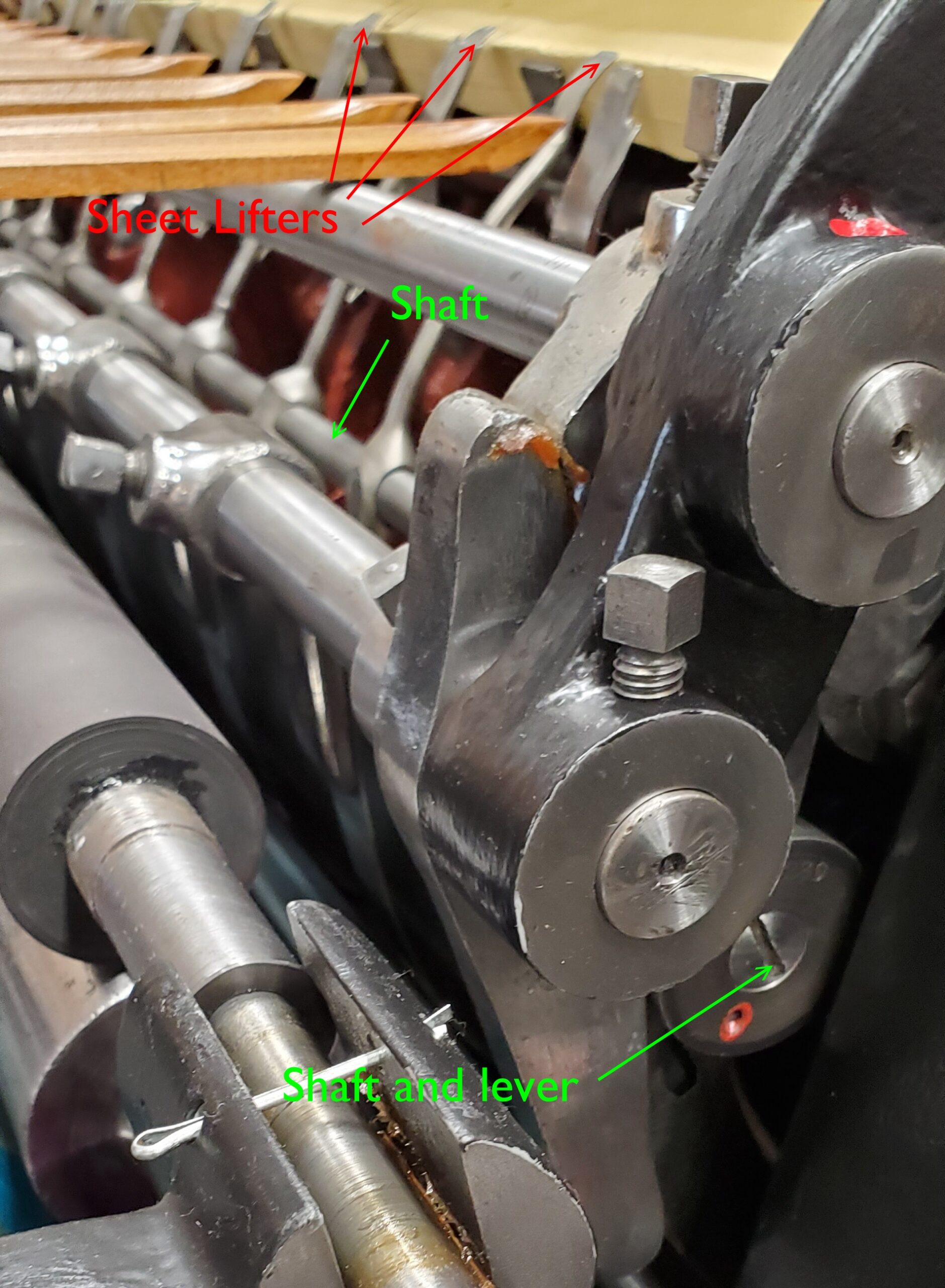
Sheet lifters and part of their mechanism on the Miehle
There is nothing on our press to operate these lifter fingers. There is a roller cam that, when pressed down, lifts the fingers (and thus the leading edge of the paper), but nothing to operate the cam.
I had a general idea of how this mechanism would work and was considering cobbling together something home-made to accomplish the task.
Well, two weekends ago when several of us, including Nick Howard, were in Wainfleet getting the press ready for this year’s Festival, someone, probably Nick, asked about the loose parts under the press. I pulled them out and, realizing that they might be the idler rollers we need, I brought the parts home for a cleanup.
 There was a rod that spanned the width of our press, one bolt to affix it, two spring-mounted idler rollers, spring-mounted slitter blade, a collar, and what appeared to be one other random lever. The rollers, slitter, and collar have set screws to clamp their position on the rod, but the lever just has an oil hole, and so is free to rotate on the bar. I eventually realized that the lever is exactly what our press needed to operate the sheet lifters, and the collar is probably to keep it in position on the rod.
During the week I made another identical bolt (as with many old press parts, the threads, ½-12TPI, are not a modern standard size) and last weekend brought the parts back to Wainfleet to try them on the press. This proved to be mostly a disappointment.
First, the mounting location for this rod could not position the rollers and slitter in any position that could work properly, though the location seemed to position the sheet-lifter lever properly. The rollers must be somewhere between the leading-edge guides and the place where the sheet lifts away from the cylinder on delivery.
Second, the rod was just a smidge too long to fit between the side frames of the press, maybe 0.01″ (0.25mm) too long.
Under the press there was another shaft with reduced-diameter ends and three solid rollers which I had not brought home for cleaning. This shaft seems to be intended to fit in two saddles on the side frames so the rollers ride on the press cylinder under their own weight and can float up as needed. The shaft and rollers would rotate as a unit, and these seemed that they could also act as idler rollers to prevent the paper from slipping on delivery. The saddles would position them perfectly for this purpose. But as with the other shaft, this one was a tad too long to fit in its home. We could have used a file to shorten the rods a bit, but given that both shafts are too long I assume that the problem is with the position of the end frames.
The press was working well enough for the Festival and we didn’t want to break it, so we left it at that. After the Festival we will see if the end frames can be loosened and moved apart just enough to allow the two shafts to be installed.
Leave a Reply