
Other notes
This is a bit of a wrap-up along with some reference links shared during the workshop
- Part 1: Introduction
- Part 2: Travel and sightseeing
- Part 3: Extracurricular activities
- Part 4: The actual papermaking workshop
A book on tool making
One book available to us during breaks was the a report on traditional Japanese papermaking tools. We had a printed copy to look through, but it is also available as a PDF file through the above link. The PDF file has text in it (rather than just page images) but I’ve been unable to get translations so far, as the PDF file is locked to prevent content copying or even printing. All I can do is take screen shots in the PDF viewer, and translate the screen shots of a page at a time. While at the workshop I was using Google Lens on my phone to get the gist of some of the contents.
The title page reads:
Record of Techniques for Making Handmade Washi Paper Tools
National Handmade Washi Paper Tools Manufacturing Technology Preservation Society
40th Anniversary Commemorative Publication
Two of the introductory pages read:
Chapter 1: A Note on Publication
I. A Greeting on the Publication (Keiko Ihara, Chairperson, National Association for the Preservation of Traditional Handmade Washi Paper Making Techniques)
The National Association for the Preservation of Handmade Washi Paper Tools was designated a nationally selected organization for the preservation of traditional techniques in 1976, and this year marks its 40th anniversary. It is with great joy that all members of the association can publish the “Record of Handmade Washi Paper Tools Production Techniques” to coincide with this momentous occasion.
Our preservation society has so far played a role in the field of handmade Japanese paper by creating tools, but as we commemorate our 40th anniversary, we would like to make even greater efforts to contribute to the preservation and development of handmade Japanese paper, a traditional craft.
Handmade washi paper from all over Japan embodies the wisdom and spirit of people’s lives in the past, and the fundamental techniques behind it are important skills that are still relevant today.
However, today, the techniques of handmade Japanese paper are being forced to change with the times, and in many cases, their continuation is at risk due to a lack of successors.
In light of these realities, we sincerely hope that the precious local handmade washi paper will be preserved and passed down to future generations. Therefore, the members of this preservation society will dedicate themselves to refining their respective tool-making techniques and training successors.
Our preservation society publishes an annual journal, “Bamboo, Wood, Thread, and the Immersion of Bamboo Baskets” (the cover of the inaugural issue is shown on the next page), which records the status of technical exchanges and skill transfer activities at training sessions, as well as the training of successors. Including these contents, we have created a technical record book that also includes valuable photographs and technical records from our predecessors, as well as the “Field Survey Report” by Professor Yanagibashi, who made significant contributions to the establishment of our preservation society.
Although this is a very modest commemorative publication, we hope that it will be of some small help in the future inheritance and development of handmade Japanese paper and the tools that support it, and we pray that the history of handmade Japanese paper and tool making in each region will be preserved and passed down for generations to come.
Lastly, I would like to express my sincere gratitude to all those involved who provided various forms of cooperation in the publication of the “Record of Techniques for Making Handmade Washi Paper Tools.”
II. On the Publication of the Technical Record of the Selected Preservation Technique “Manufacturing of Handmade Washi Paper Tools” (Cultural Properties Department, Agency for Cultural Affairs, Traditional Arts)
(Toyoko Kondo, Chief Cultural Property Investigator, Crafts and Technology Division, Cultural Affairs Section)
I would like to offer my heartfelt congratulations on the publication of the “Record of Handmade Washi Paper Making Techniques” by the National Association for the Preservation of Handmade Washi Paper Making Techniques, the organization that preserves this technique, as it marks the 40th anniversary of the designation of the “Handmade Washi Paper Making Tools” technique as a nationally designated preserved technique.
Selected preservation techniques are those techniques selected by the Minister of Education, Culture, Sports, Science and Technology under the Cultural Properties Protection Law as “traditional techniques or skills indispensable for the preservation of cultural properties that require preservation measures.” Along with the selection, the holders and preservation organizations (organizations that carry out preservation work) of these techniques are also certified. When this system was established by the amendment of the Cultural Properties Protection Law in 1975, the technique of “making tools for handmade Japanese paper” was selected the following year, 1976, along with 15 other techniques, and was quickly positioned as a technique that should be preserved by the nation. The organization certified as the preservation organization for this technique is the National Association for the Preservation of Handmade Japanese Paper Tool Making Techniques. We express our deepest respect to the members of the Preservation Association for their efforts in refining and improving the techniques for making high-quality tools and training successors, amidst the continuing difficult situation of declining demand for tools due to the decrease in handmade Japanese paper technicians and the difficulty in obtaining high-quality raw materials.
In 2014, “Sekishu Hanshi” and “Hon Mino Shi” were designated as Important Intangible Cultural Properties by the Japanese government (certified by the preserving organization).
Three techniques related to “Hosokawa paper” have been inscribed on the UNESCO Representative List of the Intangible Cultural Heritage of Humanity under the Convention for the Protection of Intangible Cultural Heritage, as “Washi: Traditional Japanese Handmade Paper Techniques.”
“Perhaps as a result of these efforts, the art of handmade Japanese paper is being re-recognized as a regional traditional culture, and initiatives to establish a foundation for its transmission are being seen in various places. One of the factors that gives Japanese handmade Japanese paper its beauty, folding resistance, and water resistance is the precisely and robustly crafted papermaking tools. We hope that this “Record of Handmade Japanese Paper Tool Manufacturing Techniques” will be used and contribute to the preservation and transmission of handmade Japanese paper tool manufacturing techniques in the future.”
For clarity, the organization was founded in 1976 and this is their 40th year, with the publication coming out in 2016. The document includes historical photos of toolmakers many of whom had passed away before publication.
One somewhat amusing thing I found using Google Lens was part of making brushes for transferring the damp paper from the post to the drying surface. There was a recipe for the glue used to hold the bristles which called for “glue, pine tar, and gold dust”. Neither Paul nor Imai-san knew what this “gold dust” referred to. After much Google searching I’ve concluded that this is a brand name of pastry flour that was available back in the day. Perhaps if we had asked an old Japanese baker they would have instantly known what this was. I found one possibly stale B2B web page listing this product and brand name, describing it as having about 8% protein and made from Canadian wheat. So the term “glue” likely refers to gelatin-based hide glue, and the “gold dust” refers to a starch paste or low-protein wheat paste, and the whole witch’s brew must have been quite a sticky mess. Unfortunately no proportions are given, nor the effects of altering proportions.
Photos of this particular brush-making process show that the glue is made up in advance as hard sticks, which are rubbed onto a hotplate to melt the required amount of glue, with the glue being applied to the bristles by dipping and spreading with a stick or spatula.
Bibliography for conservation
Clara supplied this link to a list of publications which provide specialized vocabulary for various fields one might encounter while doing conservation work.
Oguni Washi Calendar 2026
Oguni Washi produced a broadsheet calendar for 2026, and we each received a copy, on the same size paper as we were making.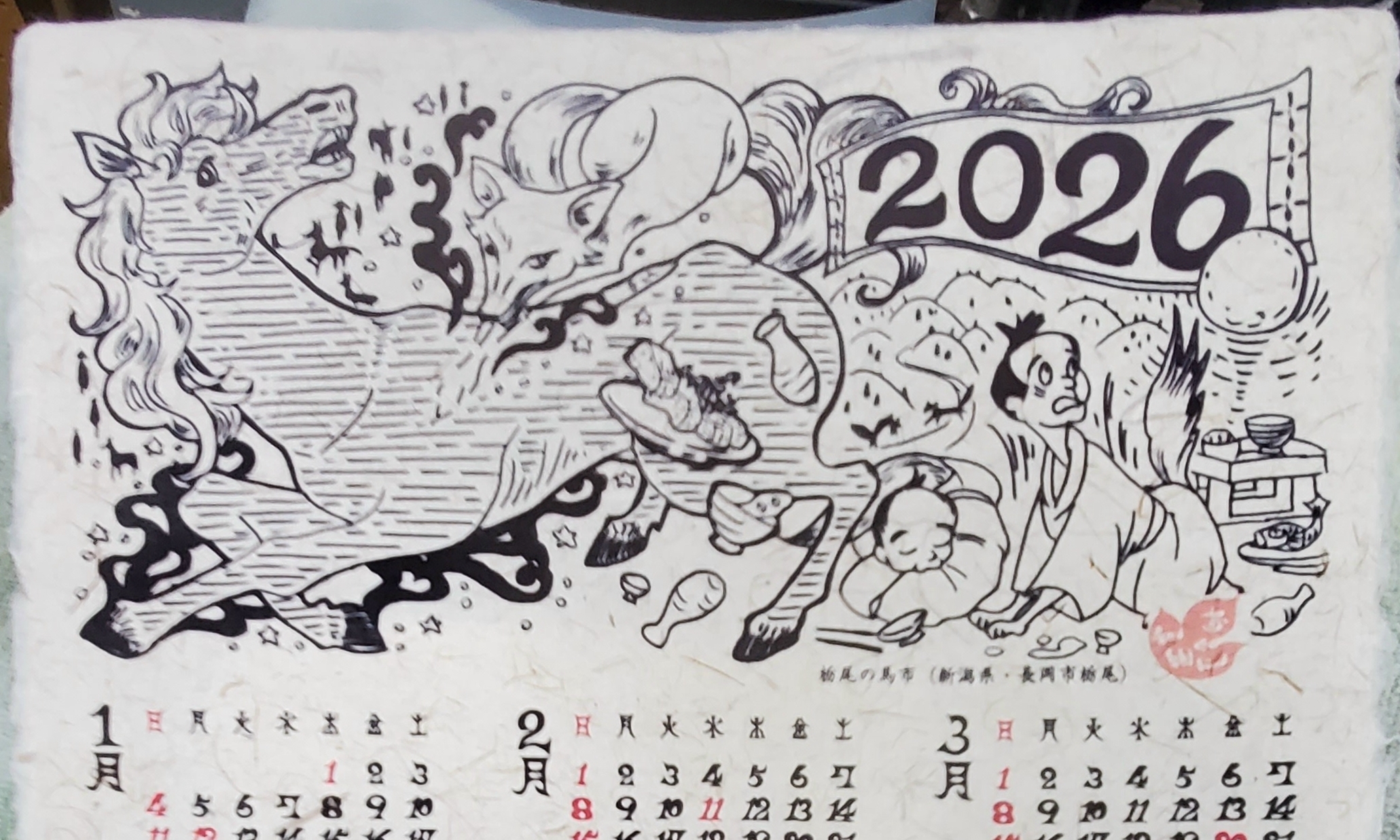 I’m not sure who actually made the illustration, but the calendar came with a sheet giving the folk tale that inspired it. One side of the sheet seems to be some translation of the other, though both sides seem to be in Japanese. Google Translate provides the following English version of the first page:
2026 Oguni Washi Original Calendar
“Tochio Horse Market”
There was a story about a wealthy man who employed a young man.
And so the master kept horses. Every morning before breakfast, the young man would go to a mountain called Kannondo to cut grass for his horses.
There lived two foxes, Sansuke and Gonsuke, on Kannondo mountain. One morning, as the young man went to Kannondo mountain to cut grass as usual, he overheard the two foxes consulting with each other.
“Gonsuke, Gonsuke. It’s alright. You and I should team up and make some money. Tomorrow is the horse market in Tochio, so I’ll transform into a horse, and you transform into the young man and drag me there to sell me at the horse market,” they said.
Then Gonsuke the fox said, “Yes, that sounds interesting.”
“If I turn into a horse and get bought, I’ll run away in the middle of the night, so you take the money and come back here right away. We’ll split it.”
And so they were making arrangements.
The young man who overheard them thought, “That’s a good idea. Tomorrow I’ll go early and lead Sansuke the fox away.”
So the next morning the young man went to where Sansuke the fox was on the mountain of Kannondo and said, “Hey, Sansuke, I’ve come to pick you up. Hurry up and turn into a horse.”
“Hey, Gonsuke, you’re quick again. You’ve transformed into a young man so well again. From your voice to your appearance, you really are just like one of the young men of my master. Alright, I’ll transform into a horse too,” he said, and he flipped over and turned into a magnificent horse.
The young man led the horse and trotted along to the horse market in Tochio, where he lined it up amongst a crowd of horses. There, a merchant named Nigoro came along and said, “This is a fine horse. How much is it?”
“Well, I’d say about five or six ryo,” the young man replied.
“Good, then if you sell it for five ryo, I’ll buy it,” the merchant said.
“Yes, that’s fine,” the young man replied, and sold the horse for five ryo.
The young man took the five ryo and went home, saying, “Mother, mother. The foxes are going to come and say something tomorrow, so please make them some red bean rice and kenchin soup.”
Meanwhile, Sansuke the fox, who had been sold as a horse, returned to the mountain of Kannondo in the middle of the night, crying “kon kon kai kai” as he transformed back into his original fox form.
“Hey Gonsuke, come here now.”
“Yes, Sansuke, where have you been?”
“What are you talking about? Where have I been? You took me to the horse market in Tochio yesterday, sold me, and brought the money back, didn’t you?”
To which he replied, “No, it wasn’t me. You weren’t there when I went to pick you up.”
“I see, in that case, one of the master’s young men must have heard what I was saying and dragged me out. In that case, I’ll transform into the master, and you come with me. Let’s go and get that money back.”
And so the two foxes went down the mountain with the master. “I’m sorry. I’m a porter who bought a horse from the young men here, but the horse ran away last night, so I’d like to have it back. If you don’t have the horse, I’d like my money back,” he said.
“Is that so? Well, come on in and have breakfast,” the mother said, so the foxes went up and sat down. Then they were served a big feast of red bean rice, kenchin soup and sake, and the foxes ate until they were full, and the sake took effect, and they fell fast asleep.
And when the sun came up, it had turned back into a fox with its big tail sticking out.
“Oh, look, a fox has come out here,” everyone said, and tried to rip it off, but the foxes said, “Oh dear, we can’t win against humans,” and timidly ran back to the mountain where Kankando Temple is located.
Strawberry popped open.From “Tochio Horse Market”
Material cooperation
Goze Song Network
(Translation on the back)
The “translation” on the back appears to also be Japanese, but with different characters, for which Google provides the slightly different English translation:
Once upon a time, there was a nobleman who had a young man working as his servant. The nobleman kept horses, and every morning before breakfast, the young man would go to a mountain called “Kannon-do” to cut grass to feed the horses.
Two foxes, Sansuke and Gonsuke, lived on the mountain where the Kannon Hall stood. One morning, as the young man went to cut grass as usual, he overheard the foxes consulting with each other.
“Gonsuke-don, Gonsuke-don. How about we team up and make some money? Tomorrow is the horse market in Tochio, so I’ll transform into a horse. You transform into a young man, lead me there, and sell me at the horse market.”
Then Gonsuke the fox said, “That sounds good, it would be fun.”
“If I’m bought as a horse, I’ll run away in the middle of the night and come back, so you bring the money and come back here right away. We’ll split it.”
That’s what they were talking about.
The young man who heard this thought, “That’s good to know. I’ll go early tomorrow and bring Sansuke the fox.”
The next morning, the young man went early to the mountain where the Kannon Hall was located and headed towards Sansuke the fox.
“Hey, Sansuke, I’ve come to pick you up. Hurry up and turn into a horse.”
Then Sansuke the fox said, “Oh, Gonsuke, you’re pretty quick. You’ve managed to transform into a young man again. Your voice and appearance are just like the young man from your master’s household. Alright, I’ll transform into a horse too.”
Saying that, he flipped over and transformed into a magnificent horse.
The young man led the horse, trotting along, to the horse market in Tochio.
I placed it in a spot where there were many other items lined up.
Then the master of a place called Nigoro came along,
“This is a good horse. How much is it?”
“Well, I’d say about five or six carriages.”
When the young man said that, the master replied, “Alright, then I’ll buy it for five ryo.”
“Yes, that’s fine.”
Thus the young man sold the horse for five ryo. He took the five ryo home and asked his mother, “Mother, mother, the foxes might come and say something tomorrow, so please make them some red bean rice and kenchin soup to treat them.”
Meanwhile, Sansuke the fox, who had been sold as a horse, returned to his original form in the middle of the night, crying “Kon kon kai kai” as he went back to the mountain where the Kannon Hall was located.
“Hey, Gonsuke, I’m home now.”
“Hey, Sansuke, where have you been?”
“What are you talking about? Where have you been? You took me to the horse market in Tochio yesterday, sold me, and brought the money back, didn’t you?”
“No, it wasn’t me. You were already gone when I went to pick you up.”
“I see, so that young man of the master must have heard our story and taken me with him. In that case, I’ll disguise myself as the master of the luggage, and you come with me. We’ll go and get that money back.”
With that, the two foxes transformed into the master and his attendant and descended the
He said, “Excuse me. I’m the man who bought a horse from the young man here, the porter’s husband. The horse ran away last night, so I’d like to have it back. If you don’t have the horse, I’d like my money back.”
“I see. Well, come on in and have breakfast.”
“That’s what the mother said, and the foxes came inside and sat down.
Then, a feast of red bean rice, kenchin soup, and sake was served, and the foxes ate until they were full, and the sake took effect, causing them to fall into a deep sleep.
Then, as the sun rose, a large tail appeared, and it transformed back into its original fox form.
“Oh, a fox has come out here!”
When everyone tried to catch them, the foxes
“Ah, we are no match for humans.”
“Here it comes,” he said, and then, with great fear, he finally managed to flee back to the mountain where the Kannon Hall was located.
It’s over.Picture pattern flower production
Oguni Washi Production Cooperative
145 Oguriyama, Oguni-machi, Nagaoka City, Niigata Prefecture
Phone 0258 (41) 9770
Supplier links
We also passed around a few links to suppliers of some materials:
Kaki-shibu
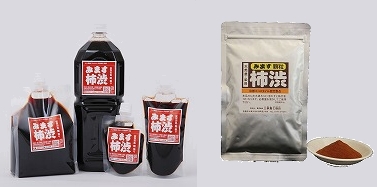 Mimasa Yoshishichi Shoten Co., Ltd. is a supplier of kaki-shibu in various forms, both liquid concentrate and powder. Although they sell by mail-order I don’t know if they ship outside of Japan. Their online order forms only support Japanese shipping destinations.
Silk sewing thread
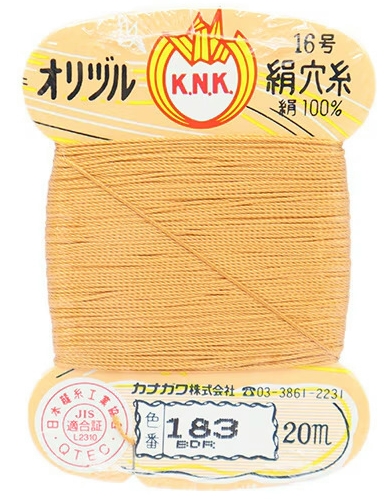 Yuzawaya Shoji Co., Ltd is a general craft supplier which was recommended as a supplier of the silk thread we used to create our wa-toji books. They have several retail locations throughout Japan, and also sell through various online shops.
The thread we were using came on small 20m cards branded KNK, from Kanagawa Co. Ltd., and based on a Google Lens translation, is labeled Oritsuru No. 16 “silk buttonhole thread”. This thread does not appear to be available through Yuzawaya’s “world” shop, but using the company’s own shopping cart system you can find this thread in 145 colours, costing ¥407 (about CAD4.00) for a 20m card. This seems to be a different ordering system than Yuzawaya’s “Online store for everyone living overseas” shopping site, and uses a forwarding service called WorldShopping, so there are additional shipping and handling fees to be considered. Items going to Canada are shipped DDU (duties unpaid) so the courier company used may have their hand out for duties and their own customs processing fees before they’ll give you the parcel.
I updated this to include the calendar