Introduction
I recently returned from a week-long workshop on Japanese papermaking at a shop in Japan. The workshop ran from March 15th-21st, and was held at Oguni Washi, located in Oguni, about 20 minutes’ drive south of Nagaoka, in the Niigata prefecture of Japan.
This post is just an introduction. Please also see the other parts of this series:
- Part 2: Travel and sightseeing
- Part 3: Extracurricular activities
- Part 4: The actual workshop
- Part 5: Other Notes
The workshop was organized and facilitated by Paul Denhoed, who in the distant past was also involved in the origins of the Papertrail, and hosted by Hiroaki and Chihiro Imai who run the paper mill. Paul is originally from Toronto but has been living in Japan for 25 years. The Imais only know a few words of English, so Paul, who speaks fluent Japanese, provided services as an interpreter. Paul did most of the teaching, with Hiroaki, whom we called Imai-san (more or less “Mr. Imai” but gender-neutral) doing most of the demonstrations and material preparations. Chihiro (also “Imai-san” when Hiroaki was not around) filled in the gaps when Horiaki was out on an errand or busy with other work.
There were four participants from diverse backgrounds: myself, Alex Bonton from Montreal but originally from France, Michele (an Italian name, so pronounced mee-kay-lay) from Singapore but originally from northern Italy, and Clara from Florida but originally from Argentina. Alex has recently hosted a su-making workshop at Bishop’s University which I attended.
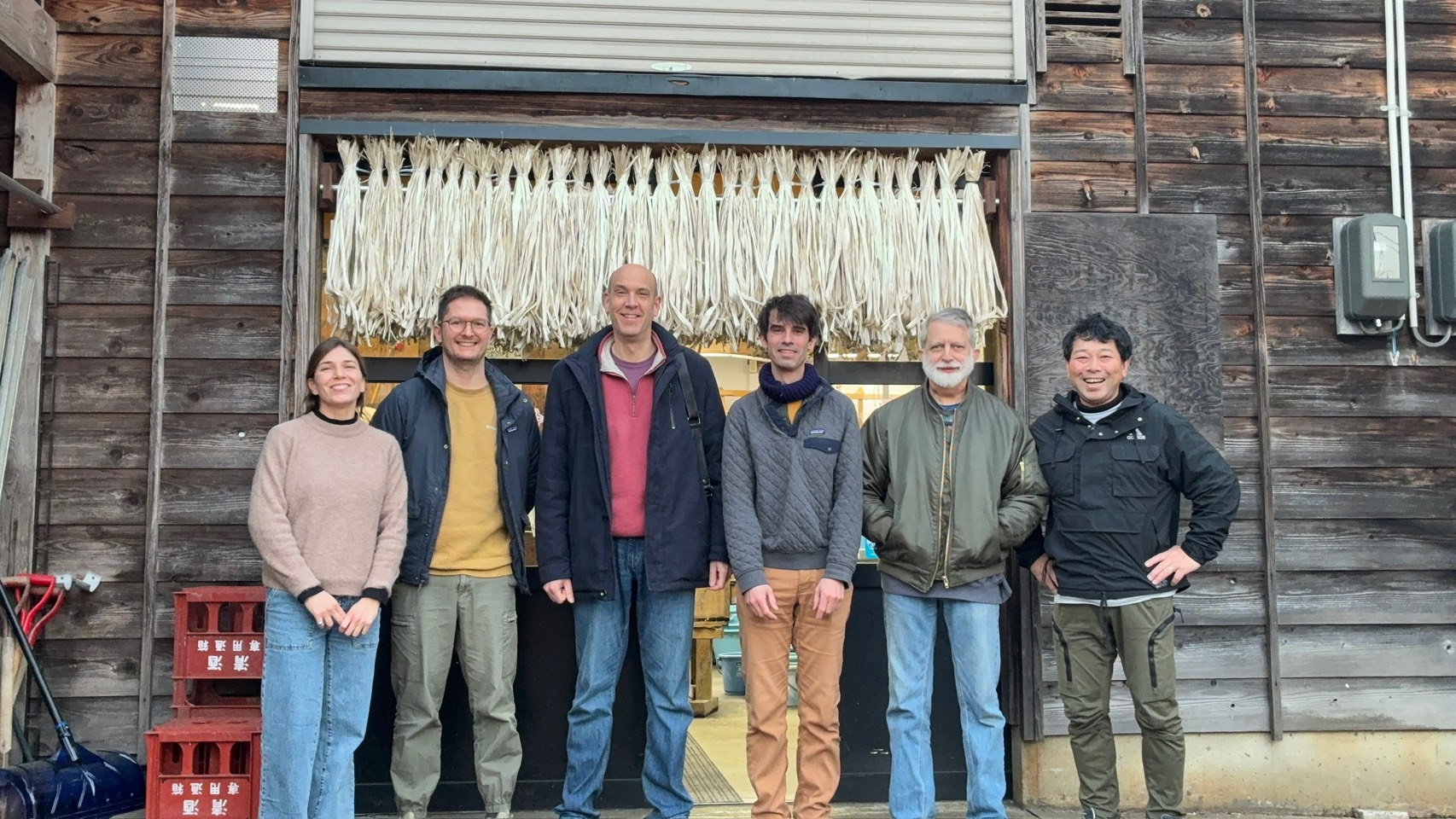
L-R: Clara, Michele, Paul, Alex, myself, and Imai-san in front of the studio (photo by Imai-san)
The Imais got into paper-making over 25 years ago, sort of inheriting the craft from Chihiro’s parents. They have been running the paper mill as a commercial enterprise for many of those years. Some of the paper they make finds its way onto labels for bottles of sake (rice wine) produced in the area, and their paper was also used as wallpaper (and ceiling covering and upholstery) throughout the Nagaoka civic centre.
They produce paper from kozo that they grow, when possible cooked using alkali from wood ash from their own cooking stoves, with other materials like kaki-shibu, konnyaku, and tororo-aoi roots being supplied from elsewhere. Some of the paper they produce qualifies as Oguni-gami (a controlled name referring to paper made using particular traditional materials and methods), but in the interests of commercial viability they will also use other methods, such as cooking with soda ash or beating using a naginata beater instead of by hand, producing paper which cannot be sold as “Oguni-gami”.
The workshop covered papermaking starting from the kozo bark all the way to finished paper, plus some additional topics such as traditional Japanese stab bindings, decorative sheet-forming, and paper treatments with konnyaku and kaki-shibu. In this spring workshop we also covered snow bleaching; there is also sometimes a fall workshop where the participants instead get a try at harvesting and stripping the kozo stems.
This post is the start of a series covering our journey through the papermaking process.
Leave a Reply