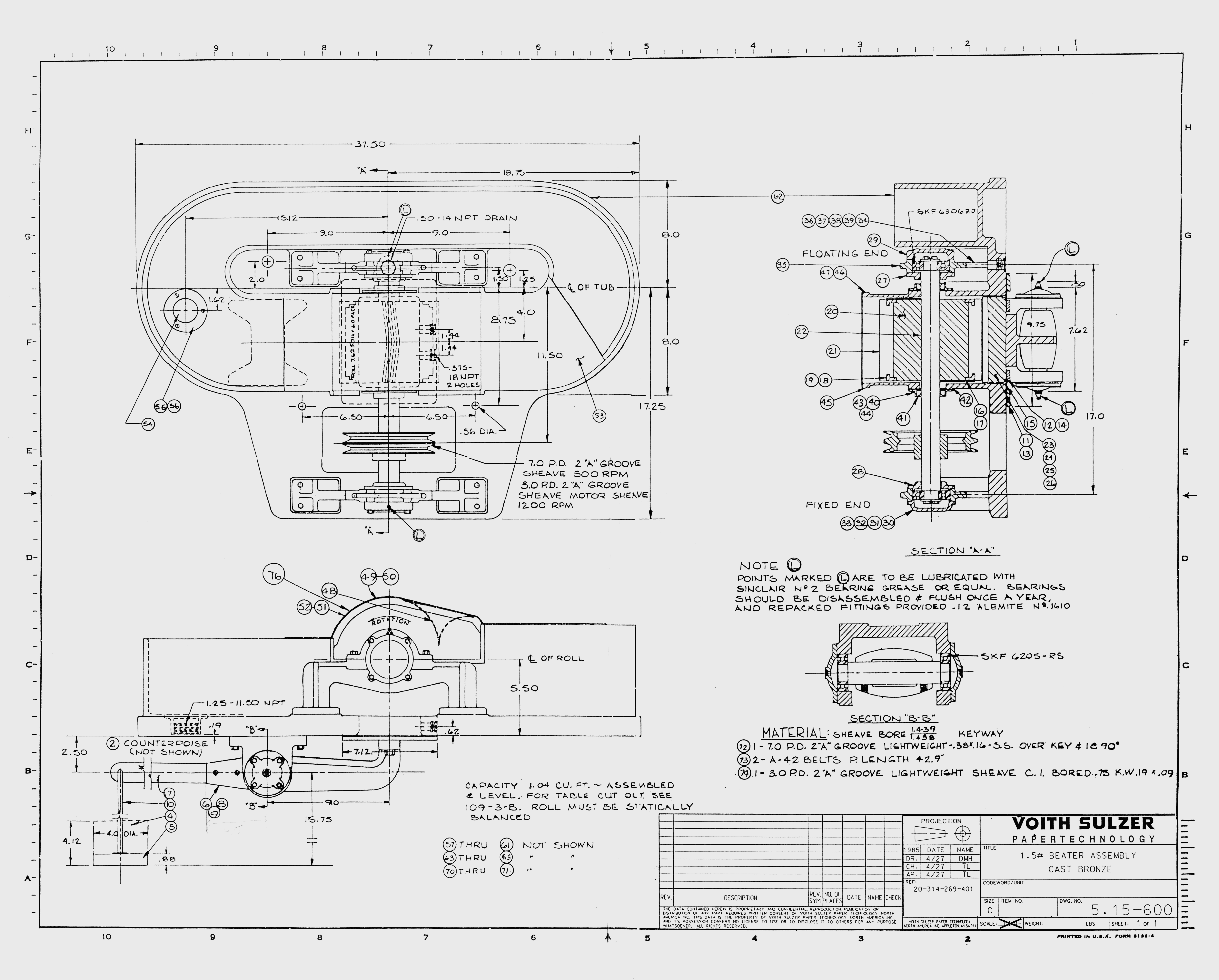
I have uploaded several documents relating to the Valley Beater regarding installation, repair, and usage. Unfortunately I’m not sure about the copyright status of these documents, nor how “fair use” and “right to repair” doctrines might apply here, so I don’t actually have any link to this page or its linked documents and I only give it out when someone needs help with a Valley Beater.
The documents are:
- An assembly drawing and accompanying parts list for the beater. I’m not sure which revision this applies to because there have been slight design changes over the years. However, these documents are useful in that they provide fastener sizes, bearing and seal numbers, types of metal used, etc.
- A price list from 1999 for spare parts. Although the actual prices are severely outdated, this document is still useful because it gives photos of some of the parts.
- Instructions for installation, operation, and maintenance of the beater including dimensions for the opening in the table/countertop.
- Templates for the tabletop cutout and for cutting your own diaphragm (the recommended material is 1/16″ gum rubber).
- An old study on how a beater works, not necessarily a Valley Beater but for Hollander beaters in general, from 1929 issues of Pulp and Paper Magazine, which was a paper industry publication in Canada.
- Instructions on grinding in the beater knives to ensure it produces test results consistent with the beaters in other laboratories. Most of the information here is more relevant to the original purpose of the Valley Beater, which was to test a pulp batch’s reaction to beating in order to plan how the pulp should be treated in a full production run. For such a purpose it was very important that the paper mill’s and pulp producer’s beaters produced relatively consistent results, and part of this involved ensuring that the edges of the beater bars had a consistent edge quality.
Most of that is unimportant when you are just using the beater as a small-batch production machine but the fundamentals of the grinding-in process are still useful.
Mind you, they do complicate the procedure somewhat with trying to isolate the tackle section of the beater to keep grit out of the tank in general. It is easier to run a batch of pulp with grit included and clean things out afterward (this includes unfastening the diaphragm so all grit can be washed out from around the bedplate).